> ## Documentation Index
> Fetch the complete documentation index at: https://docs.gloo.com/llms.txt
> Use this file to discover all available pages before exploring further.
# Realtime Upload (Deprecated)
> Learn how to build an automated pipeline that ingests content via the Realtime API.
**This API is deprecated.** Follow the [Upload Files to Data
Engine](/tutorials/upload-files) tutorial instead.
This recipe shows how to build an automated content ingestion pipeline using the Realtime API. You'll learn to set up real-time content monitoring, process various content types, and create production-ready ingestion workflows that automatically make content available for search and AI interaction.
We'll build a complete content pipeline that watches for new files, extracts metadata, and uploads content to the Gloo AI platform with proper error handling and monitoring.
## Prerequisites
Before starting, ensure you have:
* A Gloo AI Studio account
* Your Client ID and Client Secret from the [API Credentials page](/studio/manage-api-credentials)
* **Authentication setup** - Complete the [Authentication Tutorial](/tutorials/authentication) first
The Realtime Ingestion API requires Bearer token authentication. If you
haven't set up authentication yet, follow the [Authentication
Tutorial](/tutorials/authentication) to learn how to exchange your credentials
for access tokens and manage token expiration.
***
## V1 Realtime Upload \[Deprecated]
### Key Features
* **Real-time Processing**: Content is processed upon upload
* **Rich Metadata**: Support for comprehensive content categorization
* **Flexible Content Types**: Articles, documents, media, and structured content
* **Automatic Indexing**: Content becomes searchable instantly
### Step 1: Understanding the Realtime API
The Realtime Ingestion API allows you to upload content that gets processed and made available for search and AI interaction. The primary endpoint is:
**POST** `/ingestion/v1/real_time_upload`
#### Key Features
* **Real-time Processing**: Content is processed upon upload
* **Rich Metadata**: Support for comprehensive content categorization
* **Flexible Content Types**: Articles, documents, media, and structured content
* **Automatic Indexing**: Content becomes searchable instantly upon file process completion.
#### Required Fields
```json theme={null}
{
"content": "Your content text here",
"publisherId": "Your publisher id here"
}
```
#### Optional Metadata Fields
* **Content Details**: `author`, `publication_date`, `item_title`, `item_subtitle`, `item_summary`
* **Categorization**: `type`, `pub_type`, `denomination`, `item_tags`
* **Media**: `item_image`, `item_url`, `hosted_url`
* **Access Control**: `drm`, `evergreen`
* **Hierarchical Structure**: `h2_title`, `h3_title` for document sections
***
### Step 2: Basic Content Upload
Let's start with a simple content upload example. This demonstrates the core API call with proper authentication and error handling.
#### API Request Structure
The `kallm` DRM value shown in the examples below is deprecated and no longer
supported. Use `aspen` only.
```json theme={null}
{
"content": "Your article content...",
"publisherId": "b6ada63e-f1ce-4a16-80da-9864f58c5bd7",
"item_title": "Developer Happiness",
"item_subtitle": "Beyond the Code",
"author": ["Aspiring Developer"],
"publication_date": "2025-08-26",
"type": "Article",
"pub_type": "technical",
"item_tags": ["documentation", "reference"],
"evergreen": true,
"drm": ["aspen", "kallm"]
}
```
#### Expected Response
```json theme={null}
{
"success": true,
"message": "Processing started, data will be uploaded shortly.",
"task_id": null,
"batch_id": null,
"processing_details": null
}
```
***
### Step 3: Verifying Content Upload
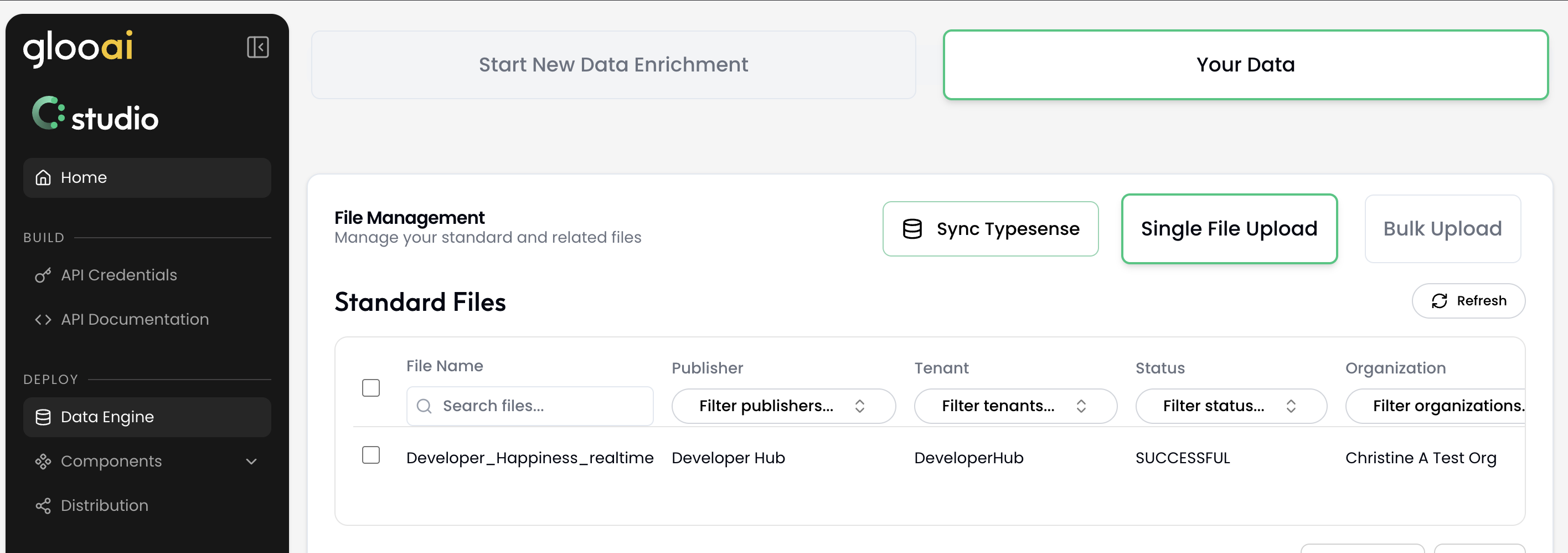
After uploading content, you can check on progress through Gloo AI Studio.
1. Log in to Gloo AI Studio.
2. Navigate to the **Data Engine** section from the main Studio sidebar.
3. Click on **Your Data**.
 ***
### Step 4: Setting Up File Monitoring
For automated content ingestion, you'll want to monitor directories for new files and automatically process them. This creates a real-time content pipeline.
#### File Watching Strategy
1. **Monitor Target Directory**: Watch for new files or changes
2. **Extract Metadata**: Parse filename and content for metadata
3. **Validate Content**: Ensure required fields are present
4. **Upload with Retry**: Handle failures gracefully
5. **Log Results**: Track successful and failed uploads
***
### Step 5: Batch Processing Pipeline
For processing multiple files or handling large volumes of content, batch processing provides better performance and resource management.
### Batch Processing Benefits
* **Rate Limiting**: Control API call frequency
* **Progress Tracking**: Monitor processing status
* **Error Recovery**: Retry failed uploads
* **Resource Management**: Efficient memory and network usage
***
### Step 6: Production Considerations
### Error Handling
* **Authentication Failures**: Token refresh and retry
* **Rate Limiting**: Exponential backoff
* **Network Issues**: Connection retry logic
* **Validation Errors**: Content preprocessing
#### Monitoring and Logging
* **Success Metrics**: Upload counts and timing
* **Error Tracking**: Failed uploads with reasons
* **Performance Monitoring**: API response times
* **Health Checks**: System status monitoring
***
### Complete Examples
The following examples combine token management, file processing, and error handling into complete, production-ready solutions for each language.
First, set up your environment variables in a `.env` file:
```
GLOO_CLIENT_ID=YOUR_CLIENT_ID
GLOO_CLIENT_SECRET=YOUR_CLIENT_SECRET
```
Or export them in your shell for Go and Java:
```bash theme={null}
export GLOO_CLIENT_ID="your_actual_client_id_here"
export GLOO_CLIENT_SECRET="your_actual_client_secret_here"
```
```python Python theme={null}
import requests
import time
import json
import os
from datetime import datetime
from watchdog.observers import Observer
from watchdog.events import FileSystemEventHandler
from dotenv import load_dotenv
# Load environment variables from .env file
load_dotenv()
# --- Configuration ---
CLIENT_ID = os.getenv("GLOO_CLIENT_ID", "YOUR_CLIENT_ID")
CLIENT_SECRET = os.getenv("GLOO_CLIENT_SECRET", "YOUR_CLIENT_SECRET")
TOKEN_URL = "https://platform.ai.gloo.com/oauth2/token"
API_URL = "https://platform.ai.gloo.com/ingestion/v1/real_time_upload"
PUBLISHER_ID = "b6ada63e-f1ce-4a16-80da-9864f58c5bd7" # Replace with your publisher ID
# --- State Management ---
access_token_info = {}
def get_access_token():
"""Retrieves a new access token."""
headers = {"Content-Type": "application/x-www-form-urlencoded"}
data = {"grant_type": "client_credentials", "scope": "api/access"}
response = requests.post(TOKEN_URL, headers=headers, data=data, auth=(CLIENT_ID, CLIENT_SECRET))
response.raise_for_status()
token_data = response.json()
token_data['expires_at'] = int(time.time()) + token_data['expires_in']
return token_data
def is_token_expired(token_info):
"""Checks if the token is expired or close to expiring."""
if not token_info or 'expires_at' not in token_info:
return True
return time.time() > (token_info['expires_at'] - 60)
def upload_content(content_data):
"""Uploads content to the Realtime API."""
global access_token_info
if is_token_expired(access_token_info):
print("Token is expired or missing. Fetching a new one...")
access_token_info = get_access_token()
headers = {
"Authorization": f"Bearer {access_token_info['access_token']}",
"Content-Type": "application/json"
}
response = requests.post(API_URL, headers=headers, json=content_data)
response.raise_for_status()
return response.json()
def process_file(file_path):
"""Processes a single file and uploads its content."""
try:
with open(file_path, 'r', encoding='utf-8') as file:
content = file.read()
# Extract metadata from filename and content
filename = os.path.basename(file_path)
title = filename.replace('.txt', '').replace('.md', '').replace('_', ' ').title()
content_data = {
"content": content,
"publisherId": PUBLISHER_ID,
"item_title": title,
"author": ["Automated Ingestion"],
"publication_date": datetime.now().strftime("%Y-%m-%d"),
"type": "Article",
"pub_type": "technical",
"item_tags": ["automated", "ingestion"],
"evergreen": True,
"drm": ["aspen", "kallm"]
}
result = upload_content(content_data)
print(f"✅ Successfully uploaded: {title}")
print(f" Response: {result['message']}")
return True
except Exception as e:
print(f"❌ Failed to process {file_path}: {e}")
return False
class ContentHandler(FileSystemEventHandler):
"""Handles file system events for content monitoring."""
def on_created(self, event):
if not event.is_directory and event.src_path.endswith(('.txt', '.md')):
print(f"📄 New file detected: {event.src_path}")
time.sleep(1) # Allow file write to complete
process_file(event.src_path)
def start_file_watcher(watch_directory):
"""Starts monitoring a directory for new content files."""
if not os.path.exists(watch_directory):
os.makedirs(watch_directory)
print(f"Created watch directory: {watch_directory}")
event_handler = ContentHandler()
observer = Observer()
observer.schedule(event_handler, watch_directory, recursive=True)
print(f"🔍 Monitoring directory: {watch_directory}")
print(" Supported file types: .txt, .md")
print(" Press Ctrl+C to stop")
observer.start()
try:
while True:
time.sleep(1)
except KeyboardInterrupt:
observer.stop()
print("\n👋 Stopping file monitor...")
observer.join()
def batch_process_directory(directory_path):
"""Processes all supported files in a directory."""
if not os.path.exists(directory_path):
print(f"Directory does not exist: {directory_path}")
return
processed = 0
failed = 0
for filename in os.listdir(directory_path):
if filename.endswith(('.txt', '.md')):
file_path = os.path.join(directory_path, filename)
if process_file(file_path):
processed += 1
else:
failed += 1
# Rate limiting - avoid overwhelming the API
time.sleep(1)
print(f"\n📊 Batch processing complete:")
print(f" ✅ Processed: {processed} files")
print(f" ❌ Failed: {failed} files")
# --- Example Usage ---
if __name__ == "__main__":
import sys
if len(sys.argv) < 2:
print("Usage:")
print(" python main.py watch # Monitor directory for new files")
print(" python main.py batch # Process all files in directory")
print(" python main.py single # Process single file")
sys.exit(1)
command = sys.argv[1]
if command == "watch" and len(sys.argv) > 2:
start_file_watcher(sys.argv[2])
elif command == "batch" and len(sys.argv) > 2:
batch_process_directory(sys.argv[2])
elif command == "single" and len(sys.argv) > 2:
process_file(sys.argv[2])
else:
print("Invalid command or missing arguments")
```
```javascript JavaScript theme={null}
const axios = require('axios');
const fs = require('fs');
const path = require('path');
const chokidar = require('chokidar');
require('dotenv').config();
// --- Configuration ---
const CLIENT_ID = process.env.GLOO_CLIENT_ID || 'YOUR_CLIENT_ID';
const CLIENT_SECRET = process.env.GLOO_CLIENT_SECRET || 'YOUR_CLIENT_SECRET';
const TOKEN_URL = 'https://platform.ai.gloo.com/oauth2/token';
const API_URL = 'https://platform.ai.gloo.com/ingestion/v1/real_time_upload';
const PUBLISHER_ID = 'b6ada63e-f1ce-4a16-80da-9864f58c5bd7'; // Replace with your publisher ID
// --- State Management ---
let tokenInfo = {};
async function getAccessToken() {
const body = 'grant_type=client_credentials&scope=api/access';
const response = await axios.post(TOKEN_URL, body, {
headers: { 'Content-Type': 'application/x-www-form-urlencoded' },
auth: { username: CLIENT_ID, password: CLIENT_SECRET },
});
const tokenData = response.data;
tokenData.expires_at = Math.floor(Date.now() / 1000) + tokenData.expires_in;
return tokenData;
}
function isTokenExpired(token) {
if (!token || !token.expires_at) return true;
return Date.now() / 1000 > token.expires_at - 60;
}
async function uploadContent(contentData) {
if (isTokenExpired(tokenInfo)) {
console.log('Token is expired or missing. Fetching a new one...');
tokenInfo = await getAccessToken();
}
const response = await axios.post(API_URL, contentData, {
headers: {
Authorization: `Bearer ${tokenInfo.access_token}`,
'Content-Type': 'application/json',
},
});
return response.data;
}
async function processFile(filePath) {
try {
const content = fs.readFileSync(filePath, 'utf8');
const filename = path.basename(filePath);
const title = filename
.replace(/\.(txt|md)$/, '')
.replace(/_/g, ' ')
.replace(/\b\w/g, (l) => l.toUpperCase());
const contentData = {
content: content,
publisherId: PUBLISHER_ID,
item_title: title,
author: ['Automated Ingestion'],
publication_date: new Date().toISOString().split('T')[0],
type: 'Article',
pub_type: 'technical',
item_tags: ['automated', 'ingestion'],
evergreen: true,
drm: ['aspen', 'kallm'],
};
const result = await uploadContent(contentData);
console.log(`✅ Successfully uploaded: ${title}`);
console.log(` Response: ${result.message}`);
return true;
} catch (error) {
console.error(
`❌ Failed to process ${filePath}:`,
error.response ? error.response.data : error.message,
);
return false;
}
}
function startFileWatcher(watchDirectory) {
if (!fs.existsSync(watchDirectory)) {
fs.mkdirSync(watchDirectory, { recursive: true });
console.log(`Created watch directory: ${watchDirectory}`);
}
console.log(`🔍 Monitoring directory: ${watchDirectory}`);
console.log(' Supported file types: .txt, .md');
console.log(' Press Ctrl+C to stop');
const watcher = chokidar.watch(watchDirectory, {
ignored: /^\./,
persistent: true,
});
watcher.on('add', async (filePath) => {
if (path.extname(filePath).match(/\.(txt|md)$/)) {
console.log(`📄 New file detected: ${filePath}`);
// Small delay to ensure file write is complete
setTimeout(() => processFile(filePath), 1000);
}
});
process.on('SIGINT', () => {
console.log('\n👋 Stopping file monitor...');
watcher.close();
process.exit(0);
});
}
async function batchProcessDirectory(directoryPath) {
if (!fs.existsSync(directoryPath)) {
console.log(`Directory does not exist: ${directoryPath}`);
return;
}
const files = fs.readdirSync(directoryPath);
const supportedFiles = files.filter((file) => file.match(/\.(txt|md)$/));
let processed = 0;
let failed = 0;
for (const filename of supportedFiles) {
const filePath = path.join(directoryPath, filename);
if (await processFile(filePath)) {
processed++;
} else {
failed++;
}
// Rate limiting - avoid overwhelming the API
await new Promise((resolve) => setTimeout(resolve, 1000));
}
console.log('\n📊 Batch processing complete:');
console.log(` ✅ Processed: ${processed} files`);
console.log(` ❌ Failed: ${failed} files`);
}
// --- Main Execution ---
async function main() {
const args = process.argv.slice(2);
if (args.length < 1) {
console.log('Usage:');
console.log(
' node index.js watch # Monitor directory for new files',
);
console.log(
' node index.js batch # Process all files in directory',
);
console.log(' node index.js single # Process single file');
process.exit(1);
}
const command = args[0];
try {
switch (command) {
case 'watch':
if (args[1]) startFileWatcher(args[1]);
else console.log('Please specify a directory to watch');
break;
case 'batch':
if (args[1]) await batchProcessDirectory(args[1]);
else console.log('Please specify a directory to process');
break;
case 'single':
if (args[1]) await processFile(args[1]);
else console.log('Please specify a file to process');
break;
default:
console.log('Invalid command. Use watch, batch, or single');
}
} catch (error) {
console.error(
'An error occurred:',
error.response ? error.response.data : error.message,
);
}
}
main();
```
```typescript TypeScript theme={null}
import axios from 'axios';
import * as fs from 'fs';
import * as path from 'path';
import chokidar from 'chokidar';
import * as dotenv from 'dotenv';
// Load environment variables from .env file
dotenv.config();
// Type definitions
interface TokenInfo {
access_token: string;
expires_in: number;
expires_at: number;
token_type: string;
}
interface ContentData {
content: string;
publisherId: string;
item_title: string;
item_subtitle?: string;
author: string[];
publication_date: string;
type: string;
pub_type: string;
item_tags: string[];
evergreen: boolean;
drm: string[];
item_summary?: string;
item_image?: string;
item_url?: string;
}
interface ApiResponse {
success: boolean;
message: string;
task_id: string | null;
batch_id: string | null;
processing_details: any | null;
}
// --- Configuration ---
const CLIENT_ID = process.env.GLOO_CLIENT_ID || 'YOUR_CLIENT_ID';
const CLIENT_SECRET = process.env.GLOO_CLIENT_SECRET || 'YOUR_CLIENT_SECRET';
const TOKEN_URL = 'https://platform.ai.gloo.com/oauth2/token';
const API_URL = 'https://platform.ai.gloo.com/ingestion/v1/real_time_upload';
const PUBLISHER_ID = 'b6ada63e-f1ce-4a16-80da-9864f58c5bd7'; // Replace with your publisher ID
// --- State Management ---
let tokenInfo: TokenInfo | null = null;
async function getAccessToken(): Promise {
const body = 'grant_type=client_credentials&scope=api/access';
const response = await axios.post(TOKEN_URL, body, {
headers: { 'Content-Type': 'application/x-www-form-urlencoded' },
auth: { username: CLIENT_ID, password: CLIENT_SECRET },
});
const tokenData = response.data;
(tokenData as any).expires_at =
Math.floor(Date.now() / 1000) + tokenData.expires_in;
return tokenData;
}
function isTokenExpired(token: TokenInfo | null): boolean {
if (!token || !(token as any).expires_at) return true;
return Date.now() / 1000 > (token as any).expires_at - 60;
}
async function uploadContent(contentData: ContentData): Promise {
if (isTokenExpired(tokenInfo)) {
console.log('Token is expired or missing. Fetching a new one...');
tokenInfo = await getAccessToken();
}
const response = await axios.post(API_URL, contentData, {
headers: {
Authorization: `Bearer ${tokenInfo!.access_token}`,
'Content-Type': 'application/json',
},
});
return response.data;
}
async function processFile(filePath: string): Promise {
try {
const content = fs.readFileSync(filePath, 'utf8');
const filename = path.basename(filePath);
const title = filename
.replace(/\.(txt|md)$/, '')
.replace(/_/g, ' ')
.replace(/\b\w/g, (l) => l.toUpperCase());
const contentData: ContentData = {
content: content,
publisherId: PUBLISHER_ID,
item_title: title,
author: ['Automated Ingestion'],
publication_date: new Date().toISOString().split('T')[0],
type: 'Article',
pub_type: 'technical',
item_tags: ['automated', 'ingestion'],
evergreen: true,
drm: ['aspen', 'kallm'],
};
const result = await uploadContent(contentData);
console.log(`✅ Successfully uploaded: ${title}`);
console.log(` Response: ${result.message}`);
return true;
} catch (error: any) {
console.error(
`❌ Failed to process ${filePath}:`,
error.response ? error.response.data : error.message,
);
return false;
}
}
function startFileWatcher(watchDirectory: string): void {
if (!fs.existsSync(watchDirectory)) {
fs.mkdirSync(watchDirectory, { recursive: true });
console.log(`Created watch directory: ${watchDirectory}`);
}
console.log(`🔍 Monitoring directory: ${watchDirectory}`);
console.log(' Supported file types: .txt, .md');
console.log(' Press Ctrl+C to stop');
const watcher = chokidar.watch(watchDirectory, {
ignored: /^\./,
persistent: true,
});
watcher.on('add', async (filePath: string) => {
if (path.extname(filePath).match(/\.(txt|md)$/)) {
console.log(`📄 New file detected: ${filePath}`);
// Small delay to ensure file write is complete
setTimeout(() => processFile(filePath), 1000);
}
});
process.on('SIGINT', () => {
console.log('\n👋 Stopping file monitor...');
watcher.close();
process.exit(0);
});
}
async function batchProcessDirectory(directoryPath: string): Promise {
if (!fs.existsSync(directoryPath)) {
console.log(`Directory does not exist: ${directoryPath}`);
return;
}
const files = fs.readdirSync(directoryPath);
const supportedFiles = files.filter((file) => file.match(/\.(txt|md)$/));
let processed = 0;
let failed = 0;
for (const filename of supportedFiles) {
const filePath = path.join(directoryPath, filename);
if (await processFile(filePath)) {
processed++;
} else {
failed++;
}
// Rate limiting - avoid overwhelming the API
await new Promise((resolve) => setTimeout(resolve, 1000));
}
console.log('\n📊 Batch processing complete:');
console.log(` ✅ Processed: ${processed} files`);
console.log(` ❌ Failed: ${failed} files`);
}
// --- Main Execution ---
async function main(): Promise {
const args = process.argv.slice(2);
if (args.length < 1) {
console.log('Usage:');
console.log(
' npx ts-node index.ts watch # Monitor directory for new files',
);
console.log(
' npx ts-node index.ts batch # Process all files in directory',
);
console.log(
' npx ts-node index.ts single # Process single file',
);
process.exit(1);
}
const command = args[0];
try {
switch (command) {
case 'watch':
if (args[1]) startFileWatcher(args[1]);
else console.log('Please specify a directory to watch');
break;
case 'batch':
if (args[1]) await batchProcessDirectory(args[1]);
else console.log('Please specify a directory to process');
break;
case 'single':
if (args[1]) await processFile(args[1]);
else console.log('Please specify a file to process');
break;
default:
console.log('Invalid command. Use watch, batch, or single');
}
} catch (error: any) {
console.error(
'An error occurred:',
error.response ? error.response.data : error.message,
);
}
}
main();
```
```php PHP theme={null}
load();
// --- Configuration ---
$CLIENT_ID = $_ENV['GLOO_CLIENT_ID'] ?? 'YOUR_CLIENT_ID';
$CLIENT_SECRET = $_ENV['GLOO_CLIENT_SECRET'] ?? 'YOUR_CLIENT_SECRET';
$TOKEN_URL = 'https://platform.ai.gloo.com/oauth2/token';
$API_URL = 'https://platform.ai.gloo.com/ingestion/v1/real_time_upload';
$PUBLISHER_ID = 'b6ada63e-f1ce-4a16-80da-9864f58c5bd7'; // Replace with your publisher ID
// Validate credentials
if ($CLIENT_ID === 'YOUR_CLIENT_ID' || $CLIENT_SECRET === 'YOUR_CLIENT_SECRET' ||
empty($CLIENT_ID) || empty($CLIENT_SECRET)) {
echo "Error: GLOO_CLIENT_ID and GLOO_CLIENT_SECRET must be set\n";
echo "Create a .env file with your credentials:\n";
echo "GLOO_CLIENT_ID=your_client_id_here\n";
echo "GLOO_CLIENT_SECRET=your_client_secret_here\n";
exit(1);
}
// --- State Management ---
$tokenInfo = [];
$httpClient = new Client();
function getAccessToken($clientId, $clientSecret, $tokenUrl, $httpClient) {
try {
$response = $httpClient->post($tokenUrl, [
'form_params' => [
'grant_type' => 'client_credentials',
'scope' => 'api/access'
],
'auth' => [$clientId, $clientSecret]
]);
$tokenData = json_decode($response->getBody(), true);
$tokenData['expires_at'] = time() + $tokenData['expires_in'];
return $tokenData;
} catch (RequestException $e) {
throw new Exception("Failed to get access token: " . $e->getMessage());
}
}
function isTokenExpired($token) {
if (empty($token) || !isset($token['expires_at'])) return true;
return time() > ($token['expires_at'] - 60);
}
function uploadContent($contentData, $apiUrl, &$tokenInfo, $clientId, $clientSecret, $tokenUrl, $httpClient) {
if (isTokenExpired($tokenInfo)) {
echo "Token is expired or missing. Fetching a new one...\n";
$tokenInfo = getAccessToken($clientId, $clientSecret, $tokenUrl, $httpClient);
}
try {
$response = $httpClient->post($apiUrl, [
'json' => $contentData,
'headers' => [
'Authorization' => 'Bearer ' . $tokenInfo['access_token'],
'Content-Type' => 'application/json'
]
]);
return json_decode($response->getBody(), true);
} catch (RequestException $e) {
throw new Exception("Upload failed: " . $e->getMessage());
}
}
function processFile($filePath, $publisherId, $apiUrl, &$tokenInfo, $clientId, $clientSecret, $tokenUrl, $httpClient) {
try {
if (!file_exists($filePath)) {
throw new Exception("File does not exist: $filePath");
}
$content = file_get_contents($filePath);
$filename = pathinfo($filePath, PATHINFO_FILENAME);
$title = str_replace(['_', '-'], ' ', $filename);
$title = ucwords($title);
$contentData = [
'content' => $content,
'publisherId' => $publisherId,
'item_title' => $title,
'author' => ['Automated Ingestion'],
'publication_date' => date('Y-m-d'),
'type' => 'Article',
'pub_type' => 'technical',
'item_tags' => ['automated', 'ingestion'],
'evergreen' => true,
'drm' => ['aspen', 'kallm']
];
$result = uploadContent($contentData, $apiUrl, $tokenInfo, $clientId, $clientSecret, $tokenUrl, $httpClient);
echo "✅ Successfully uploaded: $title\n";
echo " Response: " . $result['message'] . "\n";
return true;
} catch (Exception $e) {
echo "❌ Failed to process $filePath: " . $e->getMessage() . "\n";
return false;
}
}
function watchDirectory($watchDirectory, $publisherId, $apiUrl, &$tokenInfo, $clientId, $clientSecret, $tokenUrl, $httpClient) {
if (!is_dir($watchDirectory)) {
mkdir($watchDirectory, 0755, true);
echo "Created watch directory: $watchDirectory\n";
}
echo "🔍 Monitoring directory: $watchDirectory\n";
echo " Supported file types: .txt, .md\n";
echo " Press Ctrl+C to stop\n";
$processedFiles = [];
while (true) {
$files = glob($watchDirectory . '/*.{txt,md}', GLOB_BRACE);
foreach ($files as $file) {
$fileTime = filemtime($file);
if (!isset($processedFiles[$file]) || $processedFiles[$file] < $fileTime) {
echo "📄 New or updated file detected: $file\n";
sleep(1); // Allow file write to complete
if (processFile($file, $publisherId, $apiUrl, $tokenInfo, $clientId, $clientSecret, $tokenUrl, $httpClient)) {
$processedFiles[$file] = $fileTime;
}
}
}
sleep(2); // Check every 2 seconds
}
}
function batchProcessDirectory($directoryPath, $publisherId, $apiUrl, &$tokenInfo, $clientId, $clientSecret, $tokenUrl, $httpClient) {
if (!is_dir($directoryPath)) {
echo "Directory does not exist: $directoryPath\n";
return;
}
$files = glob($directoryPath . '/*.{txt,md}', GLOB_BRACE);
$processed = 0;
$failed = 0;
foreach ($files as $file) {
if (processFile($file, $publisherId, $apiUrl, $tokenInfo, $clientId, $clientSecret, $tokenUrl, $httpClient)) {
$processed++;
} else {
$failed++;
}
// Rate limiting - avoid overwhelming the API
sleep(1);
}
echo "\n📊 Batch processing complete:\n";
echo " ✅ Processed: $processed files\n";
echo " ❌ Failed: $failed files\n";
}
// --- Main Execution ---
if ($argc < 2) {
echo "Usage:\n";
echo " php index.php watch # Monitor directory for new files\n";
echo " php index.php batch # Process all files in directory\n";
echo " php index.php single # Process single file\n";
exit(1);
}
$command = $argv[1];
try {
switch ($command) {
case 'watch':
if (isset($argv[2])) {
watchDirectory($argv[2], $PUBLISHER_ID, $API_URL, $tokenInfo, $CLIENT_ID, $CLIENT_SECRET, $TOKEN_URL, $httpClient);
} else {
echo "Please specify a directory to watch\n";
}
break;
case 'batch':
if (isset($argv[2])) {
batchProcessDirectory($argv[2], $PUBLISHER_ID, $API_URL, $tokenInfo, $CLIENT_ID, $CLIENT_SECRET, $TOKEN_URL, $httpClient);
} else {
echo "Please specify a directory to process\n";
}
break;
case 'single':
if (isset($argv[2])) {
processFile($argv[2], $PUBLISHER_ID, $API_URL, $tokenInfo, $CLIENT_ID, $CLIENT_SECRET, $TOKEN_URL, $httpClient);
} else {
echo "Please specify a file to process\n";
}
break;
default:
echo "Invalid command. Use watch, batch, or single\n";
}
} catch (Exception $e) {
echo "Error: " . $e->getMessage() . "\n";
}
?>
```
```go Go theme={null}
package main
import (
"bytes"
"encoding/json"
"fmt"
"io/ioutil"
"net/http"
"os"
"path/filepath"
"strings"
"time"
"github.com/fsnotify/fsnotify"
"github.com/joho/godotenv"
)
// --- Configuration ---
var (
clientID string
clientSecret string
tokenURL = "https://platform.ai.gloo.com/oauth2/token"
apiURL = "https://platform.ai.gloo.com/ingestion/v1/real_time_upload"
publisherID = "b6ada63e-f1ce-4a16-80da-9864f58c5bd7" // Replace with your publisher ID
)
// --- State Management ---
var tokenInfo *TokenInfo
// --- Data Structures ---
type TokenInfo struct {
AccessToken string `json:"access_token"`
ExpiresIn int `json:"expires_in"`
ExpiresAt int64 `json:"expires_at"`
TokenType string `json:"token_type"`
}
type ContentData struct {
Content string `json:"content"`
PublisherID string `json:"publisherId"`
ItemTitle string `json:"item_title"`
Author []string `json:"author"`
PublicationDate string `json:"publication_date"`
Type string `json:"type"`
PubType string `json:"pub_type"`
ItemTags []string `json:"item_tags"`
Evergreen bool `json:"evergreen"`
DRM []string `json:"drm"`
}
type ApiResponse struct {
Success bool `json:"success"`
Message string `json:"message"`
TaskID *string `json:"task_id"`
BatchID *string `json:"batch_id"`
ProcessingDetails interface{} `json:"processing_details"`
}
// --- Function Definitions ---
func getAccessToken() (*TokenInfo, error) {
data := strings.NewReader("grant_type=client_credentials&scope=api/access")
req, err := http.NewRequest("POST", tokenURL, data)
if err != nil {
return nil, err
}
req.SetBasicAuth(clientID, clientSecret)
req.Header.Add("Content-Type", "application/x-www-form-urlencoded")
client := &http.Client{}
resp, err := client.Do(req)
if err != nil {
return nil, err
}
defer resp.Body.Close()
if resp.StatusCode != http.StatusOK {
bodyBytes, _ := ioutil.ReadAll(resp.Body)
return nil, fmt.Errorf("failed to get token: %s - %s", resp.Status, string(bodyBytes))
}
body, err := ioutil.ReadAll(resp.Body)
if err != nil {
return nil, err
}
var localTokenInfo TokenInfo
if err := json.Unmarshal(body, &localTokenInfo); err != nil {
return nil, err
}
localTokenInfo.ExpiresAt = time.Now().Unix() + int64(localTokenInfo.ExpiresIn)
return &localTokenInfo, nil
}
func isTokenExpired(token *TokenInfo) bool {
if token == nil || token.ExpiresAt == 0 {
return true
}
return time.Now().Unix() > (token.ExpiresAt - 60)
}
func uploadContent(contentData *ContentData) (*ApiResponse, error) {
var err error
if isTokenExpired(tokenInfo) {
fmt.Println("Token is expired or missing. Fetching a new one...")
tokenInfo, err = getAccessToken()
if err != nil {
return nil, err
}
}
jsonPayload, _ := json.Marshal(contentData)
req, err := http.NewRequest("POST", apiURL, bytes.NewBuffer(jsonPayload))
if err != nil {
return nil, err
}
req.Header.Add("Authorization", "Bearer "+tokenInfo.AccessToken)
req.Header.Add("Content-Type", "application/json")
client := &http.Client{}
resp, err := client.Do(req)
if err != nil {
return nil, err
}
defer resp.Body.Close()
body, _ := ioutil.ReadAll(resp.Body)
if resp.StatusCode != http.StatusOK {
return nil, fmt.Errorf("API call failed: %s - %s", resp.Status, string(body))
}
var result ApiResponse
json.Unmarshal(body, &result)
return &result, nil
}
func processFile(filePath string) bool {
content, err := ioutil.ReadFile(filePath)
if err != nil {
fmt.Printf("❌ Failed to read file %s: %v\n", filePath, err)
return false
}
filename := filepath.Base(filePath)
title := strings.TrimSuffix(filename, filepath.Ext(filename))
title = strings.ReplaceAll(title, "_", " ")
title = strings.ReplaceAll(title, "-", " ")
title = strings.Title(title)
contentData := &ContentData{
Content: string(content),
PublisherID: publisherID,
ItemTitle: title,
Author: []string{"Automated Ingestion"},
PublicationDate: time.Now().Format("2006-01-02"),
Type: "Article",
PubType: "technical",
ItemTags: []string{"automated", "ingestion"},
Evergreen: true,
DRM: []string{"aspen", "kallm"},
}
result, err := uploadContent(contentData)
if err != nil {
fmt.Printf("❌ Failed to process %s: %v\n", filePath, err)
return false
}
fmt.Printf("✅ Successfully uploaded: %s\n", title)
fmt.Printf(" Response: %s\n", result.Message)
return true
}
func watchDirectory(watchDir string) error {
// Create directory if it doesn't exist
if _, err := os.Stat(watchDir); os.IsNotExist(err) {
os.MkdirAll(watchDir, 0755)
fmt.Printf("Created watch directory: %s\n", watchDir)
}
watcher, err := fsnotify.NewWatcher()
if err != nil {
return err
}
defer watcher.Close()
fmt.Printf("🔍 Monitoring directory: %s\n", watchDir)
fmt.Println(" Supported file types: .txt, .md")
fmt.Println(" Press Ctrl+C to stop")
err = watcher.Add(watchDir)
if err != nil {
return err
}
done := make(chan bool)
go func() {
for {
select {
case event, ok := <-watcher.Events:
if !ok {
return
}
if event.Op&fsnotify.Create == fsnotify.Create {
ext := filepath.Ext(event.Name)
if ext == ".txt" || ext == ".md" {
fmt.Printf("📄 New file detected: %s\n", event.Name)
time.Sleep(1 * time.Second) // Allow file write to complete
processFile(event.Name)
}
}
case err, ok := <-watcher.Errors:
if !ok {
return
}
fmt.Printf("Error: %v\n", err)
}
}
}()
<-done
return nil
}
func batchProcessDirectory(dirPath string) {
if _, err := os.Stat(dirPath); os.IsNotExist(err) {
fmt.Printf("Directory does not exist: %s\n", dirPath)
return
}
files, err := filepath.Glob(filepath.Join(dirPath, "*.txt"))
if err != nil {
fmt.Printf("Error reading directory: %v\n", err)
return
}
mdFiles, err := filepath.Glob(filepath.Join(dirPath, "*.md"))
if err != nil {
fmt.Printf("Error reading directory: %v\n", err)
return
}
files = append(files, mdFiles...)
processed := 0
failed := 0
for _, file := range files {
if processFile(file) {
processed++
} else {
failed++
}
// Rate limiting - avoid overwhelming the API
time.Sleep(1 * time.Second)
}
fmt.Printf("\n📊 Batch processing complete:\n")
fmt.Printf(" ✅ Processed: %d files\n", processed)
fmt.Printf(" ❌ Failed: %d files\n", failed)
}
// Helper to get environment variables
func getEnv(key, fallback string) string {
if value, ok := os.LookupEnv(key); ok {
return value
}
return fallback
}
// Initialize loads environment variables and validates configuration
func init() {
// Load environment variables from .env file if it exists
_ = godotenv.Load()
// Get credentials from environment
clientID = getEnv("GLOO_CLIENT_ID", "")
clientSecret = getEnv("GLOO_CLIENT_SECRET", "")
// Validate that credentials are provided
if clientID == "" || clientSecret == "" {
fmt.Println("Error: GLOO_CLIENT_ID and GLOO_CLIENT_SECRET must be set")
fmt.Println("Either:")
fmt.Println("1. Create a .env file with your credentials:")
fmt.Println(" GLOO_CLIENT_ID=your_client_id_here")
fmt.Println(" GLOO_CLIENT_SECRET=your_client_secret_here")
fmt.Println("2. Export them as environment variables:")
fmt.Println(" export GLOO_CLIENT_ID=\"your_client_id_here\"")
fmt.Println(" export GLOO_CLIENT_SECRET=\"your_client_secret_here\"")
os.Exit(1)
}
}
// --- Main Execution ---
func main() {
if len(os.Args) < 2 {
fmt.Println("Usage:")
fmt.Println(" go run main.go watch # Monitor directory for new files")
fmt.Println(" go run main.go batch # Process all files in directory")
fmt.Println(" go run main.go single # Process single file")
os.Exit(1)
}
command := os.Args[1]
switch command {
case "watch":
if len(os.Args) > 2 {
if err := watchDirectory(os.Args[2]); err != nil {
fmt.Printf("Error watching directory: %v\n", err)
}
} else {
fmt.Println("Please specify a directory to watch")
}
case "batch":
if len(os.Args) > 2 {
batchProcessDirectory(os.Args[2])
} else {
fmt.Println("Please specify a directory to process")
}
case "single":
if len(os.Args) > 2 {
processFile(os.Args[2])
} else {
fmt.Println("Please specify a file to process")
}
default:
fmt.Println("Invalid command. Use watch, batch, or single")
}
}
```
```java Java theme={null}
import com.google.gson.Gson;
import com.google.gson.JsonObject;
import io.github.cdimascio.dotenv.Dotenv;
import java.io.IOException;
import java.net.URI;
import java.net.http.HttpClient;
import java.net.http.HttpRequest;
import java.net.http.HttpResponse;
import java.nio.file.*;
import java.time.Instant;
import java.time.LocalDate;
import java.util.Base64;
import java.util.List;
import java.util.concurrent.CompletableFuture;
import java.util.stream.Stream;
// --- Main Application Class ---
public class Main {
public static void main(String[] args) {
if (!RealtimeIngestion.validateCredentials()) {
System.exit(1);
}
if (args.length < 1) {
System.out.println("Usage:");
System.out.println(" java Main watch # Monitor directory for new files");
System.out.println(" java Main batch # Process all files in directory");
System.out.println(" java Main single # Process single file");
System.exit(1);
}
RealtimeIngestion ingestion = new RealtimeIngestion();
String command = args[0];
try {
switch (command) {
case "watch":
if (args.length > 1) {
ingestion.watchDirectory(args[1]);
} else {
System.out.println("Please specify a directory to watch");
}
break;
case "batch":
if (args.length > 1) {
ingestion.batchProcessDirectory(args[1]);
} else {
System.out.println("Please specify a directory to process");
}
break;
case "single":
if (args.length > 1) {
ingestion.processFile(args[1]);
} else {
System.out.println("Please specify a file to process");
}
break;
default:
System.out.println("Invalid command. Use watch, batch, or single");
}
} catch (Exception e) {
e.printStackTrace();
}
}
}
// --- Realtime Ingestion Class ---
class RealtimeIngestion {
// Load environment variables from .env file if it exists
private static final Dotenv dotenv = Dotenv.configure()
.ignoreIfMissing()
.load();
private static final String CLIENT_ID = dotenv.get("GLOO_CLIENT_ID", "YOUR_CLIENT_ID");
private static final String CLIENT_SECRET = dotenv.get("GLOO_CLIENT_SECRET", "YOUR_CLIENT_SECRET");
private static final String TOKEN_URL = "https://platform.ai.gloo.com/oauth2/token";
private static final String API_URL = "https://platform.ai.gloo.com/ingestion/v1/real_time_upload";
private static final String PUBLISHER_ID = "b6ada63e-f1ce-4a16-80da-9864f58c5bd7"; // Replace with your publisher ID
private TokenInfo tokenInfo;
private final HttpClient httpClient = HttpClient.newHttpClient();
private final Gson gson = new Gson();
// Validate that credentials are provided
public static boolean validateCredentials() {
if ("YOUR_CLIENT_ID".equals(CLIENT_ID) || CLIENT_ID == null || CLIENT_ID.trim().isEmpty() ||
"YOUR_CLIENT_SECRET".equals(CLIENT_SECRET) || CLIENT_SECRET == null || CLIENT_SECRET.trim().isEmpty()) {
System.err.println("Error: GLOO_CLIENT_ID and GLOO_CLIENT_SECRET must be set");
System.err.println("Create a .env file with your credentials:");
System.err.println("GLOO_CLIENT_ID=your_client_id_here");
System.err.println("GLOO_CLIENT_SECRET=your_client_secret_here");
return false;
}
return true;
}
// --- Data Classes ---
static class TokenInfo {
String access_token;
int expires_in;
long expires_at;
}
static class ContentData {
String content;
String publisherId;
String item_title;
String[] author;
String publication_date;
String type;
String pub_type;
String[] item_tags;
boolean evergreen;
String[] drm;
public ContentData(String content, String publisherId, String itemTitle) {
this.content = content;
this.publisherId = publisherId;
this.item_title = itemTitle;
this.author = new String[]{"Automated Ingestion"};
this.publication_date = LocalDate.now().toString();
this.type = "Article";
this.pub_type = "technical";
this.item_tags = new String[]{"automated", "ingestion"};
this.evergreen = true;
this.drm = new String[]{"aspen", "kallm"};
}
}
static class ApiResponse {
boolean success;
String message;
String task_id;
String batch_id;
Object processing_details;
}
// --- Token Management ---
private void fetchAccessToken() throws IOException, InterruptedException {
String auth = CLIENT_ID + ":" + CLIENT_SECRET;
String encodedAuth = Base64.getEncoder().encodeToString(auth.getBytes());
String requestBody = "grant_type=client_credentials&scope=api/access";
HttpRequest request = HttpRequest.newBuilder()
.uri(URI.create(TOKEN_URL))
.header("Content-Type", "application/x-www-form-urlencoded")
.header("Authorization", "Basic " + encodedAuth)
.POST(HttpRequest.BodyPublishers.ofString(requestBody))
.build();
HttpResponse response = httpClient.send(request, HttpResponse.BodyHandlers.ofString());
if (response.statusCode() != 200) {
throw new IOException("Failed to get token: " + response.body());
}
this.tokenInfo = gson.fromJson(response.body(), TokenInfo.class);
this.tokenInfo.expires_at = Instant.now().getEpochSecond() + this.tokenInfo.expires_in;
}
private boolean isTokenExpired() {
if (this.tokenInfo == null || this.tokenInfo.expires_at == 0) return true;
return Instant.now().getEpochSecond() > (this.tokenInfo.expires_at - 60);
}
// --- API Methods ---
public ApiResponse uploadContent(ContentData contentData) throws IOException, InterruptedException {
if (isTokenExpired()) {
System.out.println("Token is expired or missing. Fetching a new one...");
fetchAccessToken();
}
String jsonPayload = gson.toJson(contentData);
HttpRequest request = HttpRequest.newBuilder()
.uri(URI.create(API_URL))
.header("Content-Type", "application/json")
.header("Authorization", "Bearer " + this.tokenInfo.access_token)
.POST(HttpRequest.BodyPublishers.ofString(jsonPayload))
.build();
HttpResponse response = httpClient.send(request, HttpResponse.BodyHandlers.ofString());
if (response.statusCode() != 200) {
throw new IOException("API call failed: " + response.body());
}
return gson.fromJson(response.body(), ApiResponse.class);
}
public boolean processFile(String filePath) {
try {
Path path = Paths.get(filePath);
if (!Files.exists(path)) {
System.out.println("❌ File does not exist: " + filePath);
return false;
}
String content = Files.readString(path);
String filename = path.getFileName().toString();
String title = filename.replaceAll("\\.(txt|md)$", "")
.replaceAll("[_-]", " ")
.replaceAll("\\b\\w", m -> m.toUpperCase());
ContentData contentData = new ContentData(content, PUBLISHER_ID, title);
ApiResponse result = uploadContent(contentData);
System.out.println("✅ Successfully uploaded: " + title);
System.out.println(" Response: " + result.message);
return true;
} catch (Exception e) {
System.out.println("❌ Failed to process " + filePath + ": " + e.getMessage());
return false;
}
}
public void watchDirectory(String watchDir) throws IOException, InterruptedException {
Path dir = Paths.get(watchDir);
if (!Files.exists(dir)) {
Files.createDirectories(dir);
System.out.println("Created watch directory: " + watchDir);
}
System.out.println("🔍 Monitoring directory: " + watchDir);
System.out.println(" Supported file types: .txt, .md");
System.out.println(" Press Ctrl+C to stop");
WatchService watchService = FileSystems.getDefault().newWatchService();
dir.register(watchService, StandardWatchEventKinds.ENTRY_CREATE);
while (true) {
WatchKey key = watchService.take();
for (WatchEvent event : key.pollEvents()) {
if (event.kind() == StandardWatchEventKinds.ENTRY_CREATE) {
Path createdFile = dir.resolve((Path) event.context());
String fileName = createdFile.toString();
if (fileName.endsWith(".txt") || fileName.endsWith(".md")) {
System.out.println("📄 New file detected: " + createdFile);
// Small delay to ensure file write is complete
Thread.sleep(1000);
processFile(createdFile.toString());
}
}
}
key.reset();
}
}
public void batchProcessDirectory(String dirPath) {
Path dir = Paths.get(dirPath);
if (!Files.exists(dir)) {
System.out.println("Directory does not exist: " + dirPath);
return;
}
int processed = 0;
int failed = 0;
try (Stream files = Files.walk(dir, 1)) {
List supportedFiles = files
.filter(Files::isRegularFile)
.filter(p -> p.toString().endsWith(".txt") || p.toString().endsWith(".md"))
.toList();
for (Path file : supportedFiles) {
if (processFile(file.toString())) {
processed++;
} else {
failed++;
}
// Rate limiting - avoid overwhelming the API
Thread.sleep(1000);
}
} catch (Exception e) {
System.out.println("Error processing directory: " + e.getMessage());
}
System.out.println("\n📊 Batch processing complete:");
System.out.println(" ✅ Processed: " + processed + " files");
System.out.println(" ❌ Failed: " + failed + " files");
}
}
```
***
## Testing Your Implementation
To test any of the complete examples:
### 1. Environment Setup
Create a `.env` file with your Gloo AI credentials:
```
GLOO_CLIENT_ID=your_actual_client_id
GLOO_CLIENT_SECRET=your_actual_client_secret
```
### 2. Install Dependencies
Each language has specific setup requirements - check the README files in the sandbox examples.
### 3. Test Single File Upload
```bash theme={null}
# Create a test file
echo "This is a test article about automated content ingestion." > test_content.txt
# Upload the file
python main.py single test_content.txt
```
### 4. Test Directory Monitoring
```bash theme={null}
# Start monitoring a directory
python main.py watch ./watch_folder
# In another terminal, add files to the directory
echo "New content article" > ./watch_folder/new_article.txt
```
### 5. Test Batch Processing
```bash theme={null}
# Create multiple test files
mkdir batch_test
echo "Article 1 content" > batch_test/article1.txt
echo "Article 2 content" > batch_test/article2.md
# Process all files
python main.py batch ./batch_test
```
The system will:
* Automatically handle token retrieval and refresh
* Extract metadata from filenames and content
* Upload content with proper error handling
* Display success/failure status for each operation
* Provide structured JSON responses from the API
***
## Production Deployment Considerations
### Error Handling
* **Authentication**: Automatic token refresh with exponential backoff
* **Rate Limiting**: Built-in delays between API calls
* **Network Issues**: Retry logic with configurable timeouts
* **File Processing**: Validation and error recovery
### Monitoring
* **Logging**: Structured logs for all operations
* **Metrics**: Success rates, processing times, error counts
* **Alerting**: Failed upload notifications
* **Health Checks**: System status monitoring
### Scaling
* **Concurrent Processing**: Parallel file processing capabilities
* **Queue Management**: Async processing for high-volume scenarios
* **Resource Management**: Memory and CPU optimization
* **Load Balancing**: Multiple instance coordination
***
## Working Code Sample
Clone or browse the complete working examples for all 6 languages (JavaScript,
TypeScript, Python, PHP, Go, Java) with setup instructions.
## Next Steps
Now that you have a working content ingestion pipeline, consider exploring:
1. **[Search API](/api-guides/search)** - Query your ingested content
2. **[Chat Integration](/tutorials/chat)** - Use ingested content in conversations
3. **[Content Management](/studio/manage-content)** - Organize and categorize content
4. **Advanced Metadata** - Rich content classification and tagging
5. **[Custom Pipelines](/best-practices/ingestion-pattern)** - The source-agnostic pattern for integrating with a CMS, API, database, file library, or RSS feed
This tutorial provides the foundation for building sophisticated content ingestion workflows that can scale from simple file uploads to enterprise-grade automated pipelines.
***
### Step 4: Setting Up File Monitoring
For automated content ingestion, you'll want to monitor directories for new files and automatically process them. This creates a real-time content pipeline.
#### File Watching Strategy
1. **Monitor Target Directory**: Watch for new files or changes
2. **Extract Metadata**: Parse filename and content for metadata
3. **Validate Content**: Ensure required fields are present
4. **Upload with Retry**: Handle failures gracefully
5. **Log Results**: Track successful and failed uploads
***
### Step 5: Batch Processing Pipeline
For processing multiple files or handling large volumes of content, batch processing provides better performance and resource management.
### Batch Processing Benefits
* **Rate Limiting**: Control API call frequency
* **Progress Tracking**: Monitor processing status
* **Error Recovery**: Retry failed uploads
* **Resource Management**: Efficient memory and network usage
***
### Step 6: Production Considerations
### Error Handling
* **Authentication Failures**: Token refresh and retry
* **Rate Limiting**: Exponential backoff
* **Network Issues**: Connection retry logic
* **Validation Errors**: Content preprocessing
#### Monitoring and Logging
* **Success Metrics**: Upload counts and timing
* **Error Tracking**: Failed uploads with reasons
* **Performance Monitoring**: API response times
* **Health Checks**: System status monitoring
***
### Complete Examples
The following examples combine token management, file processing, and error handling into complete, production-ready solutions for each language.
First, set up your environment variables in a `.env` file:
```
GLOO_CLIENT_ID=YOUR_CLIENT_ID
GLOO_CLIENT_SECRET=YOUR_CLIENT_SECRET
```
Or export them in your shell for Go and Java:
```bash theme={null}
export GLOO_CLIENT_ID="your_actual_client_id_here"
export GLOO_CLIENT_SECRET="your_actual_client_secret_here"
```
```python Python theme={null}
import requests
import time
import json
import os
from datetime import datetime
from watchdog.observers import Observer
from watchdog.events import FileSystemEventHandler
from dotenv import load_dotenv
# Load environment variables from .env file
load_dotenv()
# --- Configuration ---
CLIENT_ID = os.getenv("GLOO_CLIENT_ID", "YOUR_CLIENT_ID")
CLIENT_SECRET = os.getenv("GLOO_CLIENT_SECRET", "YOUR_CLIENT_SECRET")
TOKEN_URL = "https://platform.ai.gloo.com/oauth2/token"
API_URL = "https://platform.ai.gloo.com/ingestion/v1/real_time_upload"
PUBLISHER_ID = "b6ada63e-f1ce-4a16-80da-9864f58c5bd7" # Replace with your publisher ID
# --- State Management ---
access_token_info = {}
def get_access_token():
"""Retrieves a new access token."""
headers = {"Content-Type": "application/x-www-form-urlencoded"}
data = {"grant_type": "client_credentials", "scope": "api/access"}
response = requests.post(TOKEN_URL, headers=headers, data=data, auth=(CLIENT_ID, CLIENT_SECRET))
response.raise_for_status()
token_data = response.json()
token_data['expires_at'] = int(time.time()) + token_data['expires_in']
return token_data
def is_token_expired(token_info):
"""Checks if the token is expired or close to expiring."""
if not token_info or 'expires_at' not in token_info:
return True
return time.time() > (token_info['expires_at'] - 60)
def upload_content(content_data):
"""Uploads content to the Realtime API."""
global access_token_info
if is_token_expired(access_token_info):
print("Token is expired or missing. Fetching a new one...")
access_token_info = get_access_token()
headers = {
"Authorization": f"Bearer {access_token_info['access_token']}",
"Content-Type": "application/json"
}
response = requests.post(API_URL, headers=headers, json=content_data)
response.raise_for_status()
return response.json()
def process_file(file_path):
"""Processes a single file and uploads its content."""
try:
with open(file_path, 'r', encoding='utf-8') as file:
content = file.read()
# Extract metadata from filename and content
filename = os.path.basename(file_path)
title = filename.replace('.txt', '').replace('.md', '').replace('_', ' ').title()
content_data = {
"content": content,
"publisherId": PUBLISHER_ID,
"item_title": title,
"author": ["Automated Ingestion"],
"publication_date": datetime.now().strftime("%Y-%m-%d"),
"type": "Article",
"pub_type": "technical",
"item_tags": ["automated", "ingestion"],
"evergreen": True,
"drm": ["aspen", "kallm"]
}
result = upload_content(content_data)
print(f"✅ Successfully uploaded: {title}")
print(f" Response: {result['message']}")
return True
except Exception as e:
print(f"❌ Failed to process {file_path}: {e}")
return False
class ContentHandler(FileSystemEventHandler):
"""Handles file system events for content monitoring."""
def on_created(self, event):
if not event.is_directory and event.src_path.endswith(('.txt', '.md')):
print(f"📄 New file detected: {event.src_path}")
time.sleep(1) # Allow file write to complete
process_file(event.src_path)
def start_file_watcher(watch_directory):
"""Starts monitoring a directory for new content files."""
if not os.path.exists(watch_directory):
os.makedirs(watch_directory)
print(f"Created watch directory: {watch_directory}")
event_handler = ContentHandler()
observer = Observer()
observer.schedule(event_handler, watch_directory, recursive=True)
print(f"🔍 Monitoring directory: {watch_directory}")
print(" Supported file types: .txt, .md")
print(" Press Ctrl+C to stop")
observer.start()
try:
while True:
time.sleep(1)
except KeyboardInterrupt:
observer.stop()
print("\n👋 Stopping file monitor...")
observer.join()
def batch_process_directory(directory_path):
"""Processes all supported files in a directory."""
if not os.path.exists(directory_path):
print(f"Directory does not exist: {directory_path}")
return
processed = 0
failed = 0
for filename in os.listdir(directory_path):
if filename.endswith(('.txt', '.md')):
file_path = os.path.join(directory_path, filename)
if process_file(file_path):
processed += 1
else:
failed += 1
# Rate limiting - avoid overwhelming the API
time.sleep(1)
print(f"\n📊 Batch processing complete:")
print(f" ✅ Processed: {processed} files")
print(f" ❌ Failed: {failed} files")
# --- Example Usage ---
if __name__ == "__main__":
import sys
if len(sys.argv) < 2:
print("Usage:")
print(" python main.py watch # Monitor directory for new files")
print(" python main.py batch # Process all files in directory")
print(" python main.py single # Process single file")
sys.exit(1)
command = sys.argv[1]
if command == "watch" and len(sys.argv) > 2:
start_file_watcher(sys.argv[2])
elif command == "batch" and len(sys.argv) > 2:
batch_process_directory(sys.argv[2])
elif command == "single" and len(sys.argv) > 2:
process_file(sys.argv[2])
else:
print("Invalid command or missing arguments")
```
```javascript JavaScript theme={null}
const axios = require('axios');
const fs = require('fs');
const path = require('path');
const chokidar = require('chokidar');
require('dotenv').config();
// --- Configuration ---
const CLIENT_ID = process.env.GLOO_CLIENT_ID || 'YOUR_CLIENT_ID';
const CLIENT_SECRET = process.env.GLOO_CLIENT_SECRET || 'YOUR_CLIENT_SECRET';
const TOKEN_URL = 'https://platform.ai.gloo.com/oauth2/token';
const API_URL = 'https://platform.ai.gloo.com/ingestion/v1/real_time_upload';
const PUBLISHER_ID = 'b6ada63e-f1ce-4a16-80da-9864f58c5bd7'; // Replace with your publisher ID
// --- State Management ---
let tokenInfo = {};
async function getAccessToken() {
const body = 'grant_type=client_credentials&scope=api/access';
const response = await axios.post(TOKEN_URL, body, {
headers: { 'Content-Type': 'application/x-www-form-urlencoded' },
auth: { username: CLIENT_ID, password: CLIENT_SECRET },
});
const tokenData = response.data;
tokenData.expires_at = Math.floor(Date.now() / 1000) + tokenData.expires_in;
return tokenData;
}
function isTokenExpired(token) {
if (!token || !token.expires_at) return true;
return Date.now() / 1000 > token.expires_at - 60;
}
async function uploadContent(contentData) {
if (isTokenExpired(tokenInfo)) {
console.log('Token is expired or missing. Fetching a new one...');
tokenInfo = await getAccessToken();
}
const response = await axios.post(API_URL, contentData, {
headers: {
Authorization: `Bearer ${tokenInfo.access_token}`,
'Content-Type': 'application/json',
},
});
return response.data;
}
async function processFile(filePath) {
try {
const content = fs.readFileSync(filePath, 'utf8');
const filename = path.basename(filePath);
const title = filename
.replace(/\.(txt|md)$/, '')
.replace(/_/g, ' ')
.replace(/\b\w/g, (l) => l.toUpperCase());
const contentData = {
content: content,
publisherId: PUBLISHER_ID,
item_title: title,
author: ['Automated Ingestion'],
publication_date: new Date().toISOString().split('T')[0],
type: 'Article',
pub_type: 'technical',
item_tags: ['automated', 'ingestion'],
evergreen: true,
drm: ['aspen', 'kallm'],
};
const result = await uploadContent(contentData);
console.log(`✅ Successfully uploaded: ${title}`);
console.log(` Response: ${result.message}`);
return true;
} catch (error) {
console.error(
`❌ Failed to process ${filePath}:`,
error.response ? error.response.data : error.message,
);
return false;
}
}
function startFileWatcher(watchDirectory) {
if (!fs.existsSync(watchDirectory)) {
fs.mkdirSync(watchDirectory, { recursive: true });
console.log(`Created watch directory: ${watchDirectory}`);
}
console.log(`🔍 Monitoring directory: ${watchDirectory}`);
console.log(' Supported file types: .txt, .md');
console.log(' Press Ctrl+C to stop');
const watcher = chokidar.watch(watchDirectory, {
ignored: /^\./,
persistent: true,
});
watcher.on('add', async (filePath) => {
if (path.extname(filePath).match(/\.(txt|md)$/)) {
console.log(`📄 New file detected: ${filePath}`);
// Small delay to ensure file write is complete
setTimeout(() => processFile(filePath), 1000);
}
});
process.on('SIGINT', () => {
console.log('\n👋 Stopping file monitor...');
watcher.close();
process.exit(0);
});
}
async function batchProcessDirectory(directoryPath) {
if (!fs.existsSync(directoryPath)) {
console.log(`Directory does not exist: ${directoryPath}`);
return;
}
const files = fs.readdirSync(directoryPath);
const supportedFiles = files.filter((file) => file.match(/\.(txt|md)$/));
let processed = 0;
let failed = 0;
for (const filename of supportedFiles) {
const filePath = path.join(directoryPath, filename);
if (await processFile(filePath)) {
processed++;
} else {
failed++;
}
// Rate limiting - avoid overwhelming the API
await new Promise((resolve) => setTimeout(resolve, 1000));
}
console.log('\n📊 Batch processing complete:');
console.log(` ✅ Processed: ${processed} files`);
console.log(` ❌ Failed: ${failed} files`);
}
// --- Main Execution ---
async function main() {
const args = process.argv.slice(2);
if (args.length < 1) {
console.log('Usage:');
console.log(
' node index.js watch # Monitor directory for new files',
);
console.log(
' node index.js batch # Process all files in directory',
);
console.log(' node index.js single # Process single file');
process.exit(1);
}
const command = args[0];
try {
switch (command) {
case 'watch':
if (args[1]) startFileWatcher(args[1]);
else console.log('Please specify a directory to watch');
break;
case 'batch':
if (args[1]) await batchProcessDirectory(args[1]);
else console.log('Please specify a directory to process');
break;
case 'single':
if (args[1]) await processFile(args[1]);
else console.log('Please specify a file to process');
break;
default:
console.log('Invalid command. Use watch, batch, or single');
}
} catch (error) {
console.error(
'An error occurred:',
error.response ? error.response.data : error.message,
);
}
}
main();
```
```typescript TypeScript theme={null}
import axios from 'axios';
import * as fs from 'fs';
import * as path from 'path';
import chokidar from 'chokidar';
import * as dotenv from 'dotenv';
// Load environment variables from .env file
dotenv.config();
// Type definitions
interface TokenInfo {
access_token: string;
expires_in: number;
expires_at: number;
token_type: string;
}
interface ContentData {
content: string;
publisherId: string;
item_title: string;
item_subtitle?: string;
author: string[];
publication_date: string;
type: string;
pub_type: string;
item_tags: string[];
evergreen: boolean;
drm: string[];
item_summary?: string;
item_image?: string;
item_url?: string;
}
interface ApiResponse {
success: boolean;
message: string;
task_id: string | null;
batch_id: string | null;
processing_details: any | null;
}
// --- Configuration ---
const CLIENT_ID = process.env.GLOO_CLIENT_ID || 'YOUR_CLIENT_ID';
const CLIENT_SECRET = process.env.GLOO_CLIENT_SECRET || 'YOUR_CLIENT_SECRET';
const TOKEN_URL = 'https://platform.ai.gloo.com/oauth2/token';
const API_URL = 'https://platform.ai.gloo.com/ingestion/v1/real_time_upload';
const PUBLISHER_ID = 'b6ada63e-f1ce-4a16-80da-9864f58c5bd7'; // Replace with your publisher ID
// --- State Management ---
let tokenInfo: TokenInfo | null = null;
async function getAccessToken(): Promise {
const body = 'grant_type=client_credentials&scope=api/access';
const response = await axios.post(TOKEN_URL, body, {
headers: { 'Content-Type': 'application/x-www-form-urlencoded' },
auth: { username: CLIENT_ID, password: CLIENT_SECRET },
});
const tokenData = response.data;
(tokenData as any).expires_at =
Math.floor(Date.now() / 1000) + tokenData.expires_in;
return tokenData;
}
function isTokenExpired(token: TokenInfo | null): boolean {
if (!token || !(token as any).expires_at) return true;
return Date.now() / 1000 > (token as any).expires_at - 60;
}
async function uploadContent(contentData: ContentData): Promise {
if (isTokenExpired(tokenInfo)) {
console.log('Token is expired or missing. Fetching a new one...');
tokenInfo = await getAccessToken();
}
const response = await axios.post(API_URL, contentData, {
headers: {
Authorization: `Bearer ${tokenInfo!.access_token}`,
'Content-Type': 'application/json',
},
});
return response.data;
}
async function processFile(filePath: string): Promise {
try {
const content = fs.readFileSync(filePath, 'utf8');
const filename = path.basename(filePath);
const title = filename
.replace(/\.(txt|md)$/, '')
.replace(/_/g, ' ')
.replace(/\b\w/g, (l) => l.toUpperCase());
const contentData: ContentData = {
content: content,
publisherId: PUBLISHER_ID,
item_title: title,
author: ['Automated Ingestion'],
publication_date: new Date().toISOString().split('T')[0],
type: 'Article',
pub_type: 'technical',
item_tags: ['automated', 'ingestion'],
evergreen: true,
drm: ['aspen', 'kallm'],
};
const result = await uploadContent(contentData);
console.log(`✅ Successfully uploaded: ${title}`);
console.log(` Response: ${result.message}`);
return true;
} catch (error: any) {
console.error(
`❌ Failed to process ${filePath}:`,
error.response ? error.response.data : error.message,
);
return false;
}
}
function startFileWatcher(watchDirectory: string): void {
if (!fs.existsSync(watchDirectory)) {
fs.mkdirSync(watchDirectory, { recursive: true });
console.log(`Created watch directory: ${watchDirectory}`);
}
console.log(`🔍 Monitoring directory: ${watchDirectory}`);
console.log(' Supported file types: .txt, .md');
console.log(' Press Ctrl+C to stop');
const watcher = chokidar.watch(watchDirectory, {
ignored: /^\./,
persistent: true,
});
watcher.on('add', async (filePath: string) => {
if (path.extname(filePath).match(/\.(txt|md)$/)) {
console.log(`📄 New file detected: ${filePath}`);
// Small delay to ensure file write is complete
setTimeout(() => processFile(filePath), 1000);
}
});
process.on('SIGINT', () => {
console.log('\n👋 Stopping file monitor...');
watcher.close();
process.exit(0);
});
}
async function batchProcessDirectory(directoryPath: string): Promise {
if (!fs.existsSync(directoryPath)) {
console.log(`Directory does not exist: ${directoryPath}`);
return;
}
const files = fs.readdirSync(directoryPath);
const supportedFiles = files.filter((file) => file.match(/\.(txt|md)$/));
let processed = 0;
let failed = 0;
for (const filename of supportedFiles) {
const filePath = path.join(directoryPath, filename);
if (await processFile(filePath)) {
processed++;
} else {
failed++;
}
// Rate limiting - avoid overwhelming the API
await new Promise((resolve) => setTimeout(resolve, 1000));
}
console.log('\n📊 Batch processing complete:');
console.log(` ✅ Processed: ${processed} files`);
console.log(` ❌ Failed: ${failed} files`);
}
// --- Main Execution ---
async function main(): Promise {
const args = process.argv.slice(2);
if (args.length < 1) {
console.log('Usage:');
console.log(
' npx ts-node index.ts watch # Monitor directory for new files',
);
console.log(
' npx ts-node index.ts batch # Process all files in directory',
);
console.log(
' npx ts-node index.ts single # Process single file',
);
process.exit(1);
}
const command = args[0];
try {
switch (command) {
case 'watch':
if (args[1]) startFileWatcher(args[1]);
else console.log('Please specify a directory to watch');
break;
case 'batch':
if (args[1]) await batchProcessDirectory(args[1]);
else console.log('Please specify a directory to process');
break;
case 'single':
if (args[1]) await processFile(args[1]);
else console.log('Please specify a file to process');
break;
default:
console.log('Invalid command. Use watch, batch, or single');
}
} catch (error: any) {
console.error(
'An error occurred:',
error.response ? error.response.data : error.message,
);
}
}
main();
```
```php PHP theme={null}
load();
// --- Configuration ---
$CLIENT_ID = $_ENV['GLOO_CLIENT_ID'] ?? 'YOUR_CLIENT_ID';
$CLIENT_SECRET = $_ENV['GLOO_CLIENT_SECRET'] ?? 'YOUR_CLIENT_SECRET';
$TOKEN_URL = 'https://platform.ai.gloo.com/oauth2/token';
$API_URL = 'https://platform.ai.gloo.com/ingestion/v1/real_time_upload';
$PUBLISHER_ID = 'b6ada63e-f1ce-4a16-80da-9864f58c5bd7'; // Replace with your publisher ID
// Validate credentials
if ($CLIENT_ID === 'YOUR_CLIENT_ID' || $CLIENT_SECRET === 'YOUR_CLIENT_SECRET' ||
empty($CLIENT_ID) || empty($CLIENT_SECRET)) {
echo "Error: GLOO_CLIENT_ID and GLOO_CLIENT_SECRET must be set\n";
echo "Create a .env file with your credentials:\n";
echo "GLOO_CLIENT_ID=your_client_id_here\n";
echo "GLOO_CLIENT_SECRET=your_client_secret_here\n";
exit(1);
}
// --- State Management ---
$tokenInfo = [];
$httpClient = new Client();
function getAccessToken($clientId, $clientSecret, $tokenUrl, $httpClient) {
try {
$response = $httpClient->post($tokenUrl, [
'form_params' => [
'grant_type' => 'client_credentials',
'scope' => 'api/access'
],
'auth' => [$clientId, $clientSecret]
]);
$tokenData = json_decode($response->getBody(), true);
$tokenData['expires_at'] = time() + $tokenData['expires_in'];
return $tokenData;
} catch (RequestException $e) {
throw new Exception("Failed to get access token: " . $e->getMessage());
}
}
function isTokenExpired($token) {
if (empty($token) || !isset($token['expires_at'])) return true;
return time() > ($token['expires_at'] - 60);
}
function uploadContent($contentData, $apiUrl, &$tokenInfo, $clientId, $clientSecret, $tokenUrl, $httpClient) {
if (isTokenExpired($tokenInfo)) {
echo "Token is expired or missing. Fetching a new one...\n";
$tokenInfo = getAccessToken($clientId, $clientSecret, $tokenUrl, $httpClient);
}
try {
$response = $httpClient->post($apiUrl, [
'json' => $contentData,
'headers' => [
'Authorization' => 'Bearer ' . $tokenInfo['access_token'],
'Content-Type' => 'application/json'
]
]);
return json_decode($response->getBody(), true);
} catch (RequestException $e) {
throw new Exception("Upload failed: " . $e->getMessage());
}
}
function processFile($filePath, $publisherId, $apiUrl, &$tokenInfo, $clientId, $clientSecret, $tokenUrl, $httpClient) {
try {
if (!file_exists($filePath)) {
throw new Exception("File does not exist: $filePath");
}
$content = file_get_contents($filePath);
$filename = pathinfo($filePath, PATHINFO_FILENAME);
$title = str_replace(['_', '-'], ' ', $filename);
$title = ucwords($title);
$contentData = [
'content' => $content,
'publisherId' => $publisherId,
'item_title' => $title,
'author' => ['Automated Ingestion'],
'publication_date' => date('Y-m-d'),
'type' => 'Article',
'pub_type' => 'technical',
'item_tags' => ['automated', 'ingestion'],
'evergreen' => true,
'drm' => ['aspen', 'kallm']
];
$result = uploadContent($contentData, $apiUrl, $tokenInfo, $clientId, $clientSecret, $tokenUrl, $httpClient);
echo "✅ Successfully uploaded: $title\n";
echo " Response: " . $result['message'] . "\n";
return true;
} catch (Exception $e) {
echo "❌ Failed to process $filePath: " . $e->getMessage() . "\n";
return false;
}
}
function watchDirectory($watchDirectory, $publisherId, $apiUrl, &$tokenInfo, $clientId, $clientSecret, $tokenUrl, $httpClient) {
if (!is_dir($watchDirectory)) {
mkdir($watchDirectory, 0755, true);
echo "Created watch directory: $watchDirectory\n";
}
echo "🔍 Monitoring directory: $watchDirectory\n";
echo " Supported file types: .txt, .md\n";
echo " Press Ctrl+C to stop\n";
$processedFiles = [];
while (true) {
$files = glob($watchDirectory . '/*.{txt,md}', GLOB_BRACE);
foreach ($files as $file) {
$fileTime = filemtime($file);
if (!isset($processedFiles[$file]) || $processedFiles[$file] < $fileTime) {
echo "📄 New or updated file detected: $file\n";
sleep(1); // Allow file write to complete
if (processFile($file, $publisherId, $apiUrl, $tokenInfo, $clientId, $clientSecret, $tokenUrl, $httpClient)) {
$processedFiles[$file] = $fileTime;
}
}
}
sleep(2); // Check every 2 seconds
}
}
function batchProcessDirectory($directoryPath, $publisherId, $apiUrl, &$tokenInfo, $clientId, $clientSecret, $tokenUrl, $httpClient) {
if (!is_dir($directoryPath)) {
echo "Directory does not exist: $directoryPath\n";
return;
}
$files = glob($directoryPath . '/*.{txt,md}', GLOB_BRACE);
$processed = 0;
$failed = 0;
foreach ($files as $file) {
if (processFile($file, $publisherId, $apiUrl, $tokenInfo, $clientId, $clientSecret, $tokenUrl, $httpClient)) {
$processed++;
} else {
$failed++;
}
// Rate limiting - avoid overwhelming the API
sleep(1);
}
echo "\n📊 Batch processing complete:\n";
echo " ✅ Processed: $processed files\n";
echo " ❌ Failed: $failed files\n";
}
// --- Main Execution ---
if ($argc < 2) {
echo "Usage:\n";
echo " php index.php watch # Monitor directory for new files\n";
echo " php index.php batch # Process all files in directory\n";
echo " php index.php single # Process single file\n";
exit(1);
}
$command = $argv[1];
try {
switch ($command) {
case 'watch':
if (isset($argv[2])) {
watchDirectory($argv[2], $PUBLISHER_ID, $API_URL, $tokenInfo, $CLIENT_ID, $CLIENT_SECRET, $TOKEN_URL, $httpClient);
} else {
echo "Please specify a directory to watch\n";
}
break;
case 'batch':
if (isset($argv[2])) {
batchProcessDirectory($argv[2], $PUBLISHER_ID, $API_URL, $tokenInfo, $CLIENT_ID, $CLIENT_SECRET, $TOKEN_URL, $httpClient);
} else {
echo "Please specify a directory to process\n";
}
break;
case 'single':
if (isset($argv[2])) {
processFile($argv[2], $PUBLISHER_ID, $API_URL, $tokenInfo, $CLIENT_ID, $CLIENT_SECRET, $TOKEN_URL, $httpClient);
} else {
echo "Please specify a file to process\n";
}
break;
default:
echo "Invalid command. Use watch, batch, or single\n";
}
} catch (Exception $e) {
echo "Error: " . $e->getMessage() . "\n";
}
?>
```
```go Go theme={null}
package main
import (
"bytes"
"encoding/json"
"fmt"
"io/ioutil"
"net/http"
"os"
"path/filepath"
"strings"
"time"
"github.com/fsnotify/fsnotify"
"github.com/joho/godotenv"
)
// --- Configuration ---
var (
clientID string
clientSecret string
tokenURL = "https://platform.ai.gloo.com/oauth2/token"
apiURL = "https://platform.ai.gloo.com/ingestion/v1/real_time_upload"
publisherID = "b6ada63e-f1ce-4a16-80da-9864f58c5bd7" // Replace with your publisher ID
)
// --- State Management ---
var tokenInfo *TokenInfo
// --- Data Structures ---
type TokenInfo struct {
AccessToken string `json:"access_token"`
ExpiresIn int `json:"expires_in"`
ExpiresAt int64 `json:"expires_at"`
TokenType string `json:"token_type"`
}
type ContentData struct {
Content string `json:"content"`
PublisherID string `json:"publisherId"`
ItemTitle string `json:"item_title"`
Author []string `json:"author"`
PublicationDate string `json:"publication_date"`
Type string `json:"type"`
PubType string `json:"pub_type"`
ItemTags []string `json:"item_tags"`
Evergreen bool `json:"evergreen"`
DRM []string `json:"drm"`
}
type ApiResponse struct {
Success bool `json:"success"`
Message string `json:"message"`
TaskID *string `json:"task_id"`
BatchID *string `json:"batch_id"`
ProcessingDetails interface{} `json:"processing_details"`
}
// --- Function Definitions ---
func getAccessToken() (*TokenInfo, error) {
data := strings.NewReader("grant_type=client_credentials&scope=api/access")
req, err := http.NewRequest("POST", tokenURL, data)
if err != nil {
return nil, err
}
req.SetBasicAuth(clientID, clientSecret)
req.Header.Add("Content-Type", "application/x-www-form-urlencoded")
client := &http.Client{}
resp, err := client.Do(req)
if err != nil {
return nil, err
}
defer resp.Body.Close()
if resp.StatusCode != http.StatusOK {
bodyBytes, _ := ioutil.ReadAll(resp.Body)
return nil, fmt.Errorf("failed to get token: %s - %s", resp.Status, string(bodyBytes))
}
body, err := ioutil.ReadAll(resp.Body)
if err != nil {
return nil, err
}
var localTokenInfo TokenInfo
if err := json.Unmarshal(body, &localTokenInfo); err != nil {
return nil, err
}
localTokenInfo.ExpiresAt = time.Now().Unix() + int64(localTokenInfo.ExpiresIn)
return &localTokenInfo, nil
}
func isTokenExpired(token *TokenInfo) bool {
if token == nil || token.ExpiresAt == 0 {
return true
}
return time.Now().Unix() > (token.ExpiresAt - 60)
}
func uploadContent(contentData *ContentData) (*ApiResponse, error) {
var err error
if isTokenExpired(tokenInfo) {
fmt.Println("Token is expired or missing. Fetching a new one...")
tokenInfo, err = getAccessToken()
if err != nil {
return nil, err
}
}
jsonPayload, _ := json.Marshal(contentData)
req, err := http.NewRequest("POST", apiURL, bytes.NewBuffer(jsonPayload))
if err != nil {
return nil, err
}
req.Header.Add("Authorization", "Bearer "+tokenInfo.AccessToken)
req.Header.Add("Content-Type", "application/json")
client := &http.Client{}
resp, err := client.Do(req)
if err != nil {
return nil, err
}
defer resp.Body.Close()
body, _ := ioutil.ReadAll(resp.Body)
if resp.StatusCode != http.StatusOK {
return nil, fmt.Errorf("API call failed: %s - %s", resp.Status, string(body))
}
var result ApiResponse
json.Unmarshal(body, &result)
return &result, nil
}
func processFile(filePath string) bool {
content, err := ioutil.ReadFile(filePath)
if err != nil {
fmt.Printf("❌ Failed to read file %s: %v\n", filePath, err)
return false
}
filename := filepath.Base(filePath)
title := strings.TrimSuffix(filename, filepath.Ext(filename))
title = strings.ReplaceAll(title, "_", " ")
title = strings.ReplaceAll(title, "-", " ")
title = strings.Title(title)
contentData := &ContentData{
Content: string(content),
PublisherID: publisherID,
ItemTitle: title,
Author: []string{"Automated Ingestion"},
PublicationDate: time.Now().Format("2006-01-02"),
Type: "Article",
PubType: "technical",
ItemTags: []string{"automated", "ingestion"},
Evergreen: true,
DRM: []string{"aspen", "kallm"},
}
result, err := uploadContent(contentData)
if err != nil {
fmt.Printf("❌ Failed to process %s: %v\n", filePath, err)
return false
}
fmt.Printf("✅ Successfully uploaded: %s\n", title)
fmt.Printf(" Response: %s\n", result.Message)
return true
}
func watchDirectory(watchDir string) error {
// Create directory if it doesn't exist
if _, err := os.Stat(watchDir); os.IsNotExist(err) {
os.MkdirAll(watchDir, 0755)
fmt.Printf("Created watch directory: %s\n", watchDir)
}
watcher, err := fsnotify.NewWatcher()
if err != nil {
return err
}
defer watcher.Close()
fmt.Printf("🔍 Monitoring directory: %s\n", watchDir)
fmt.Println(" Supported file types: .txt, .md")
fmt.Println(" Press Ctrl+C to stop")
err = watcher.Add(watchDir)
if err != nil {
return err
}
done := make(chan bool)
go func() {
for {
select {
case event, ok := <-watcher.Events:
if !ok {
return
}
if event.Op&fsnotify.Create == fsnotify.Create {
ext := filepath.Ext(event.Name)
if ext == ".txt" || ext == ".md" {
fmt.Printf("📄 New file detected: %s\n", event.Name)
time.Sleep(1 * time.Second) // Allow file write to complete
processFile(event.Name)
}
}
case err, ok := <-watcher.Errors:
if !ok {
return
}
fmt.Printf("Error: %v\n", err)
}
}
}()
<-done
return nil
}
func batchProcessDirectory(dirPath string) {
if _, err := os.Stat(dirPath); os.IsNotExist(err) {
fmt.Printf("Directory does not exist: %s\n", dirPath)
return
}
files, err := filepath.Glob(filepath.Join(dirPath, "*.txt"))
if err != nil {
fmt.Printf("Error reading directory: %v\n", err)
return
}
mdFiles, err := filepath.Glob(filepath.Join(dirPath, "*.md"))
if err != nil {
fmt.Printf("Error reading directory: %v\n", err)
return
}
files = append(files, mdFiles...)
processed := 0
failed := 0
for _, file := range files {
if processFile(file) {
processed++
} else {
failed++
}
// Rate limiting - avoid overwhelming the API
time.Sleep(1 * time.Second)
}
fmt.Printf("\n📊 Batch processing complete:\n")
fmt.Printf(" ✅ Processed: %d files\n", processed)
fmt.Printf(" ❌ Failed: %d files\n", failed)
}
// Helper to get environment variables
func getEnv(key, fallback string) string {
if value, ok := os.LookupEnv(key); ok {
return value
}
return fallback
}
// Initialize loads environment variables and validates configuration
func init() {
// Load environment variables from .env file if it exists
_ = godotenv.Load()
// Get credentials from environment
clientID = getEnv("GLOO_CLIENT_ID", "")
clientSecret = getEnv("GLOO_CLIENT_SECRET", "")
// Validate that credentials are provided
if clientID == "" || clientSecret == "" {
fmt.Println("Error: GLOO_CLIENT_ID and GLOO_CLIENT_SECRET must be set")
fmt.Println("Either:")
fmt.Println("1. Create a .env file with your credentials:")
fmt.Println(" GLOO_CLIENT_ID=your_client_id_here")
fmt.Println(" GLOO_CLIENT_SECRET=your_client_secret_here")
fmt.Println("2. Export them as environment variables:")
fmt.Println(" export GLOO_CLIENT_ID=\"your_client_id_here\"")
fmt.Println(" export GLOO_CLIENT_SECRET=\"your_client_secret_here\"")
os.Exit(1)
}
}
// --- Main Execution ---
func main() {
if len(os.Args) < 2 {
fmt.Println("Usage:")
fmt.Println(" go run main.go watch # Monitor directory for new files")
fmt.Println(" go run main.go batch # Process all files in directory")
fmt.Println(" go run main.go single # Process single file")
os.Exit(1)
}
command := os.Args[1]
switch command {
case "watch":
if len(os.Args) > 2 {
if err := watchDirectory(os.Args[2]); err != nil {
fmt.Printf("Error watching directory: %v\n", err)
}
} else {
fmt.Println("Please specify a directory to watch")
}
case "batch":
if len(os.Args) > 2 {
batchProcessDirectory(os.Args[2])
} else {
fmt.Println("Please specify a directory to process")
}
case "single":
if len(os.Args) > 2 {
processFile(os.Args[2])
} else {
fmt.Println("Please specify a file to process")
}
default:
fmt.Println("Invalid command. Use watch, batch, or single")
}
}
```
```java Java theme={null}
import com.google.gson.Gson;
import com.google.gson.JsonObject;
import io.github.cdimascio.dotenv.Dotenv;
import java.io.IOException;
import java.net.URI;
import java.net.http.HttpClient;
import java.net.http.HttpRequest;
import java.net.http.HttpResponse;
import java.nio.file.*;
import java.time.Instant;
import java.time.LocalDate;
import java.util.Base64;
import java.util.List;
import java.util.concurrent.CompletableFuture;
import java.util.stream.Stream;
// --- Main Application Class ---
public class Main {
public static void main(String[] args) {
if (!RealtimeIngestion.validateCredentials()) {
System.exit(1);
}
if (args.length < 1) {
System.out.println("Usage:");
System.out.println(" java Main watch # Monitor directory for new files");
System.out.println(" java Main batch # Process all files in directory");
System.out.println(" java Main single # Process single file");
System.exit(1);
}
RealtimeIngestion ingestion = new RealtimeIngestion();
String command = args[0];
try {
switch (command) {
case "watch":
if (args.length > 1) {
ingestion.watchDirectory(args[1]);
} else {
System.out.println("Please specify a directory to watch");
}
break;
case "batch":
if (args.length > 1) {
ingestion.batchProcessDirectory(args[1]);
} else {
System.out.println("Please specify a directory to process");
}
break;
case "single":
if (args.length > 1) {
ingestion.processFile(args[1]);
} else {
System.out.println("Please specify a file to process");
}
break;
default:
System.out.println("Invalid command. Use watch, batch, or single");
}
} catch (Exception e) {
e.printStackTrace();
}
}
}
// --- Realtime Ingestion Class ---
class RealtimeIngestion {
// Load environment variables from .env file if it exists
private static final Dotenv dotenv = Dotenv.configure()
.ignoreIfMissing()
.load();
private static final String CLIENT_ID = dotenv.get("GLOO_CLIENT_ID", "YOUR_CLIENT_ID");
private static final String CLIENT_SECRET = dotenv.get("GLOO_CLIENT_SECRET", "YOUR_CLIENT_SECRET");
private static final String TOKEN_URL = "https://platform.ai.gloo.com/oauth2/token";
private static final String API_URL = "https://platform.ai.gloo.com/ingestion/v1/real_time_upload";
private static final String PUBLISHER_ID = "b6ada63e-f1ce-4a16-80da-9864f58c5bd7"; // Replace with your publisher ID
private TokenInfo tokenInfo;
private final HttpClient httpClient = HttpClient.newHttpClient();
private final Gson gson = new Gson();
// Validate that credentials are provided
public static boolean validateCredentials() {
if ("YOUR_CLIENT_ID".equals(CLIENT_ID) || CLIENT_ID == null || CLIENT_ID.trim().isEmpty() ||
"YOUR_CLIENT_SECRET".equals(CLIENT_SECRET) || CLIENT_SECRET == null || CLIENT_SECRET.trim().isEmpty()) {
System.err.println("Error: GLOO_CLIENT_ID and GLOO_CLIENT_SECRET must be set");
System.err.println("Create a .env file with your credentials:");
System.err.println("GLOO_CLIENT_ID=your_client_id_here");
System.err.println("GLOO_CLIENT_SECRET=your_client_secret_here");
return false;
}
return true;
}
// --- Data Classes ---
static class TokenInfo {
String access_token;
int expires_in;
long expires_at;
}
static class ContentData {
String content;
String publisherId;
String item_title;
String[] author;
String publication_date;
String type;
String pub_type;
String[] item_tags;
boolean evergreen;
String[] drm;
public ContentData(String content, String publisherId, String itemTitle) {
this.content = content;
this.publisherId = publisherId;
this.item_title = itemTitle;
this.author = new String[]{"Automated Ingestion"};
this.publication_date = LocalDate.now().toString();
this.type = "Article";
this.pub_type = "technical";
this.item_tags = new String[]{"automated", "ingestion"};
this.evergreen = true;
this.drm = new String[]{"aspen", "kallm"};
}
}
static class ApiResponse {
boolean success;
String message;
String task_id;
String batch_id;
Object processing_details;
}
// --- Token Management ---
private void fetchAccessToken() throws IOException, InterruptedException {
String auth = CLIENT_ID + ":" + CLIENT_SECRET;
String encodedAuth = Base64.getEncoder().encodeToString(auth.getBytes());
String requestBody = "grant_type=client_credentials&scope=api/access";
HttpRequest request = HttpRequest.newBuilder()
.uri(URI.create(TOKEN_URL))
.header("Content-Type", "application/x-www-form-urlencoded")
.header("Authorization", "Basic " + encodedAuth)
.POST(HttpRequest.BodyPublishers.ofString(requestBody))
.build();
HttpResponse response = httpClient.send(request, HttpResponse.BodyHandlers.ofString());
if (response.statusCode() != 200) {
throw new IOException("Failed to get token: " + response.body());
}
this.tokenInfo = gson.fromJson(response.body(), TokenInfo.class);
this.tokenInfo.expires_at = Instant.now().getEpochSecond() + this.tokenInfo.expires_in;
}
private boolean isTokenExpired() {
if (this.tokenInfo == null || this.tokenInfo.expires_at == 0) return true;
return Instant.now().getEpochSecond() > (this.tokenInfo.expires_at - 60);
}
// --- API Methods ---
public ApiResponse uploadContent(ContentData contentData) throws IOException, InterruptedException {
if (isTokenExpired()) {
System.out.println("Token is expired or missing. Fetching a new one...");
fetchAccessToken();
}
String jsonPayload = gson.toJson(contentData);
HttpRequest request = HttpRequest.newBuilder()
.uri(URI.create(API_URL))
.header("Content-Type", "application/json")
.header("Authorization", "Bearer " + this.tokenInfo.access_token)
.POST(HttpRequest.BodyPublishers.ofString(jsonPayload))
.build();
HttpResponse response = httpClient.send(request, HttpResponse.BodyHandlers.ofString());
if (response.statusCode() != 200) {
throw new IOException("API call failed: " + response.body());
}
return gson.fromJson(response.body(), ApiResponse.class);
}
public boolean processFile(String filePath) {
try {
Path path = Paths.get(filePath);
if (!Files.exists(path)) {
System.out.println("❌ File does not exist: " + filePath);
return false;
}
String content = Files.readString(path);
String filename = path.getFileName().toString();
String title = filename.replaceAll("\\.(txt|md)$", "")
.replaceAll("[_-]", " ")
.replaceAll("\\b\\w", m -> m.toUpperCase());
ContentData contentData = new ContentData(content, PUBLISHER_ID, title);
ApiResponse result = uploadContent(contentData);
System.out.println("✅ Successfully uploaded: " + title);
System.out.println(" Response: " + result.message);
return true;
} catch (Exception e) {
System.out.println("❌ Failed to process " + filePath + ": " + e.getMessage());
return false;
}
}
public void watchDirectory(String watchDir) throws IOException, InterruptedException {
Path dir = Paths.get(watchDir);
if (!Files.exists(dir)) {
Files.createDirectories(dir);
System.out.println("Created watch directory: " + watchDir);
}
System.out.println("🔍 Monitoring directory: " + watchDir);
System.out.println(" Supported file types: .txt, .md");
System.out.println(" Press Ctrl+C to stop");
WatchService watchService = FileSystems.getDefault().newWatchService();
dir.register(watchService, StandardWatchEventKinds.ENTRY_CREATE);
while (true) {
WatchKey key = watchService.take();
for (WatchEvent event : key.pollEvents()) {
if (event.kind() == StandardWatchEventKinds.ENTRY_CREATE) {
Path createdFile = dir.resolve((Path) event.context());
String fileName = createdFile.toString();
if (fileName.endsWith(".txt") || fileName.endsWith(".md")) {
System.out.println("📄 New file detected: " + createdFile);
// Small delay to ensure file write is complete
Thread.sleep(1000);
processFile(createdFile.toString());
}
}
}
key.reset();
}
}
public void batchProcessDirectory(String dirPath) {
Path dir = Paths.get(dirPath);
if (!Files.exists(dir)) {
System.out.println("Directory does not exist: " + dirPath);
return;
}
int processed = 0;
int failed = 0;
try (Stream files = Files.walk(dir, 1)) {
List supportedFiles = files
.filter(Files::isRegularFile)
.filter(p -> p.toString().endsWith(".txt") || p.toString().endsWith(".md"))
.toList();
for (Path file : supportedFiles) {
if (processFile(file.toString())) {
processed++;
} else {
failed++;
}
// Rate limiting - avoid overwhelming the API
Thread.sleep(1000);
}
} catch (Exception e) {
System.out.println("Error processing directory: " + e.getMessage());
}
System.out.println("\n📊 Batch processing complete:");
System.out.println(" ✅ Processed: " + processed + " files");
System.out.println(" ❌ Failed: " + failed + " files");
}
}
```
***
## Testing Your Implementation
To test any of the complete examples:
### 1. Environment Setup
Create a `.env` file with your Gloo AI credentials:
```
GLOO_CLIENT_ID=your_actual_client_id
GLOO_CLIENT_SECRET=your_actual_client_secret
```
### 2. Install Dependencies
Each language has specific setup requirements - check the README files in the sandbox examples.
### 3. Test Single File Upload
```bash theme={null}
# Create a test file
echo "This is a test article about automated content ingestion." > test_content.txt
# Upload the file
python main.py single test_content.txt
```
### 4. Test Directory Monitoring
```bash theme={null}
# Start monitoring a directory
python main.py watch ./watch_folder
# In another terminal, add files to the directory
echo "New content article" > ./watch_folder/new_article.txt
```
### 5. Test Batch Processing
```bash theme={null}
# Create multiple test files
mkdir batch_test
echo "Article 1 content" > batch_test/article1.txt
echo "Article 2 content" > batch_test/article2.md
# Process all files
python main.py batch ./batch_test
```
The system will:
* Automatically handle token retrieval and refresh
* Extract metadata from filenames and content
* Upload content with proper error handling
* Display success/failure status for each operation
* Provide structured JSON responses from the API
***
## Production Deployment Considerations
### Error Handling
* **Authentication**: Automatic token refresh with exponential backoff
* **Rate Limiting**: Built-in delays between API calls
* **Network Issues**: Retry logic with configurable timeouts
* **File Processing**: Validation and error recovery
### Monitoring
* **Logging**: Structured logs for all operations
* **Metrics**: Success rates, processing times, error counts
* **Alerting**: Failed upload notifications
* **Health Checks**: System status monitoring
### Scaling
* **Concurrent Processing**: Parallel file processing capabilities
* **Queue Management**: Async processing for high-volume scenarios
* **Resource Management**: Memory and CPU optimization
* **Load Balancing**: Multiple instance coordination
***
## Working Code Sample
Clone or browse the complete working examples for all 6 languages (JavaScript,
TypeScript, Python, PHP, Go, Java) with setup instructions.
## Next Steps
Now that you have a working content ingestion pipeline, consider exploring:
1. **[Search API](/api-guides/search)** - Query your ingested content
2. **[Chat Integration](/tutorials/chat)** - Use ingested content in conversations
3. **[Content Management](/studio/manage-content)** - Organize and categorize content
4. **Advanced Metadata** - Rich content classification and tagging
5. **[Custom Pipelines](/best-practices/ingestion-pattern)** - The source-agnostic pattern for integrating with a CMS, API, database, file library, or RSS feed
This tutorial provides the foundation for building sophisticated content ingestion workflows that can scale from simple file uploads to enterprise-grade automated pipelines.