

/analytics/cost) combines token usage, model economics, workflow and factory costs, entity attribution, procedure compute, cache efficiency, and reconciliation. Use the data-source badge to distinguish real event data from an empty source.
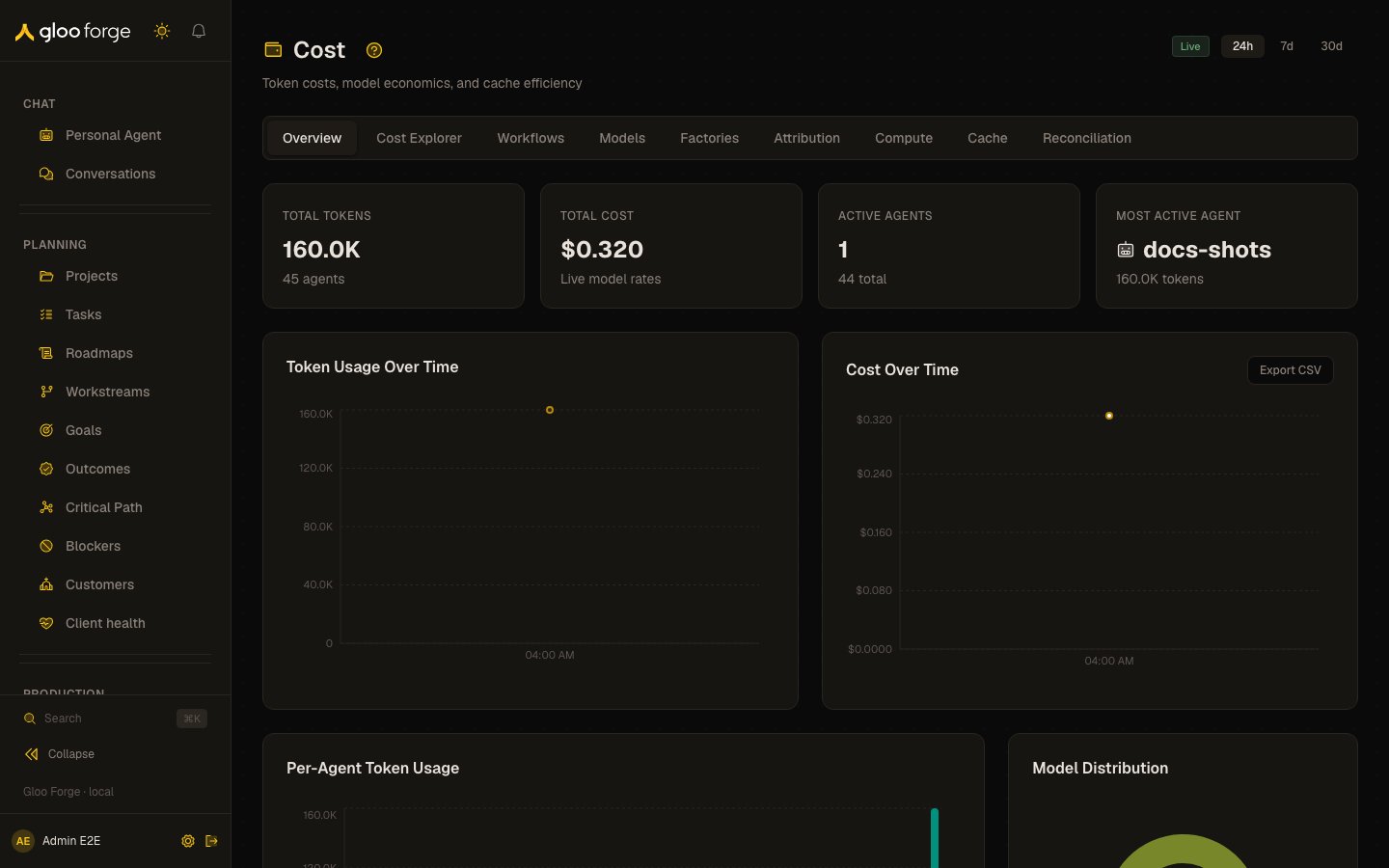
Cost — Forge Console at /analytics/cost
What you can do
- Switch between Overview, Cost Explorer, Workflows, Models, Factories, Attribution, Compute, Cache, and Reconciliation.
- Time-bound supported views to 24 hours, 7 days, or 30 days.
- Export CSV from views that expose Export CSV.
- Compare totals only after checking the tab’s source and time window; workflow totals and token-event totals are intentionally labeled separately.
Key state to watch
- Source and window — confirm both before comparing tabs or exporting evidence.
- Attribution gaps — inspect unattributed or unexpectedly grouped spend instead of assuming it is zero.
- Reconciliation drift — use the named pass and its skipped count to understand what was actually compared.
Reconciliation tab
The Reconciliation tab is where spend that does not add up becomes visible. Three independent reconcilers compare a different pair of numbers, and each writes to the same drift feed:
A run’s
totalCost keeps every attempt’s spend: rerunning a step adds the new attempt’s cost to the earlier one’s. A step row shows only its latest attempt’s cost, so the weekly step pass leaves reran runs out, and the daily ledger pass checks them.
The summary tiles are anchored to one named pass — the line above them says which — because the three do not count the same thing (the counters pass counts agents, the other two count runs). Read the tab as five tiles:
- Last Run / Runs Checked — when that pass ran, and how many runs (or agents) it actually compared.
- Drifts Found / Total Drift — how many comparisons exceeded the $0.01 threshold, and by how much in total.
- Skipped — runs the pass excluded because their sandbox-lease scan hit its cap. Their booked compute is a floor rather than a total, so the run is not comparable and would drift by construction. A non-zero value here is the reason Runs Checked is smaller than the sample; it is not a defect count.
cost:manage; for anyone else the click ends without running it, and the page shows no error. The drift table is exportable to CSV.