

/planning/outcomes) lists the business results Forge has materialized from completed workflow runs. Where a run tells you what executed, an outcome tells you what was achieved — and every claim on it points back at the record that supports it.
An outcome is not written by the workflow. The graph emits facts; a governed outcome definition decides what those facts mean, and an outcome binding authorizes one pinned workflow version to make the claim. A run whose version has no binding completes normally and simply reports not_declared.
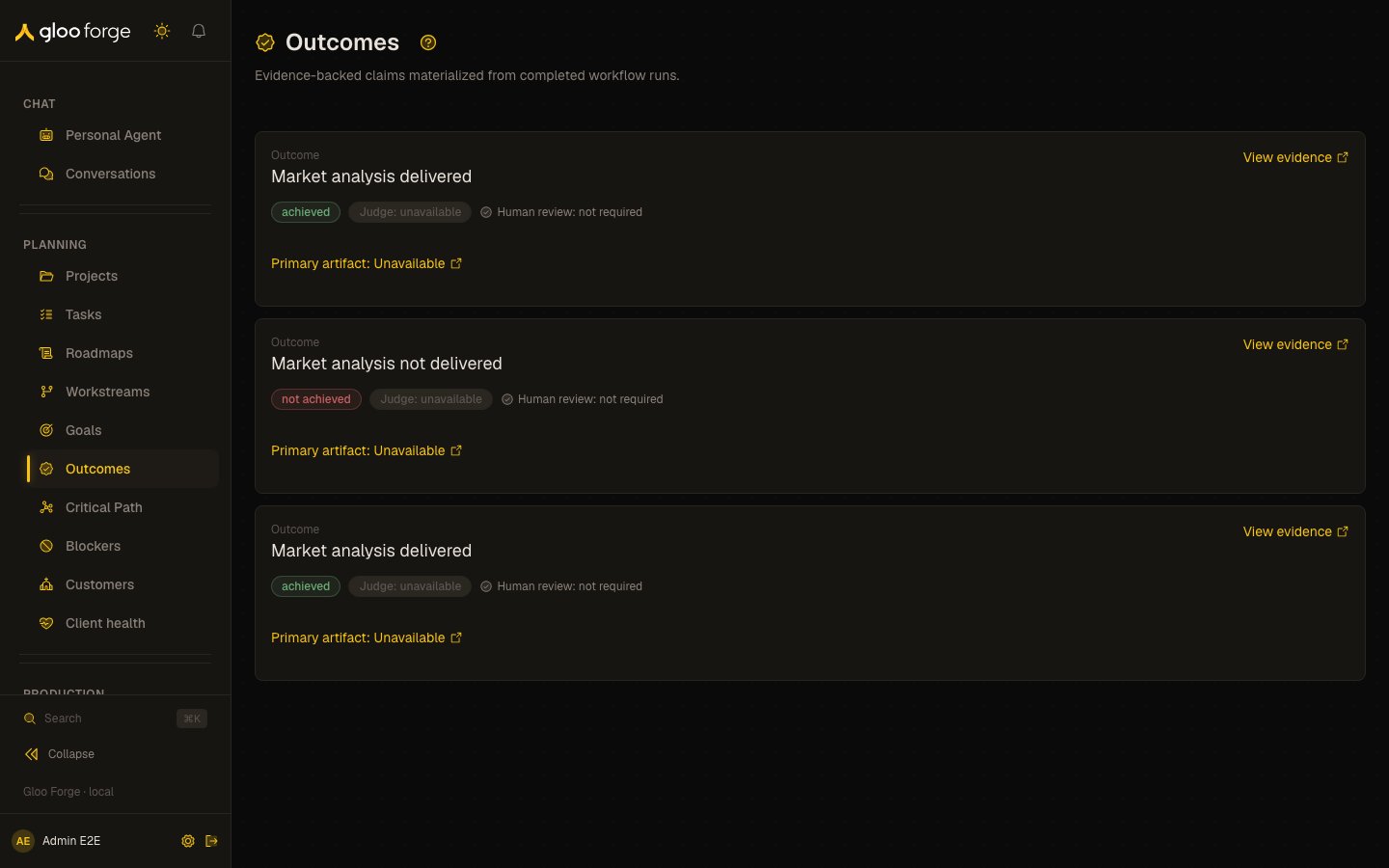
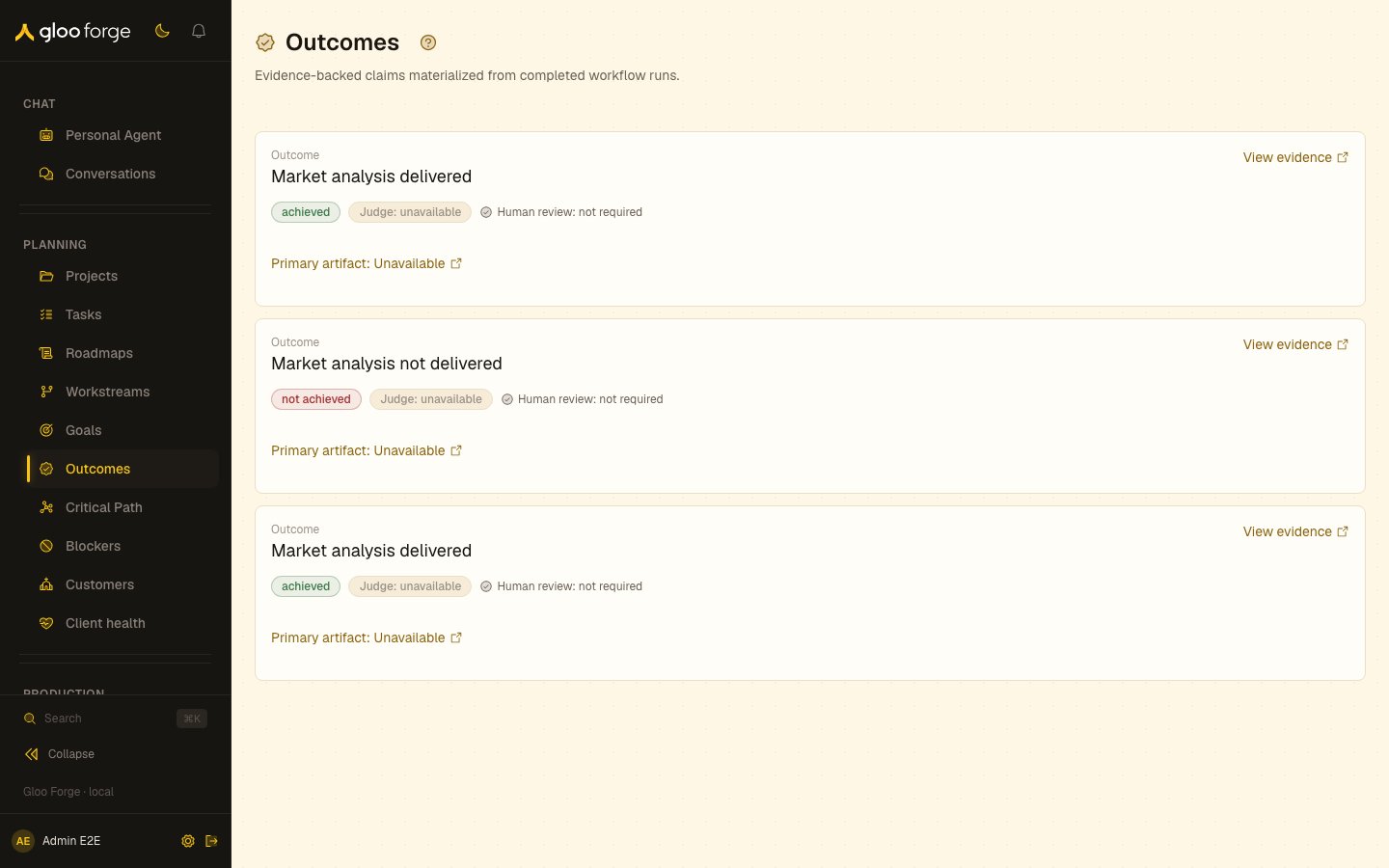
Outcomes — Forge Console at /planning/outcomes
What you can do
- Review recent outcomes with their claimed status, Judge verdict, human-review disposition, and exception count.
- Open an outcome’s dossier to inspect its metrics, exceptions, primary artifact, and Trust receipt.
- Jump from a workflow run straight to the outcome it produced, via View outcome evidence in the run header.
- Rate an outcome from 1 to 5 stars, with optional notes, from its dossier or from Rate outcome in the run header.
- Trace an outcome back to the request that started it, and forward to the project and objective it contributes to.
Claimed status
Status is derived by the definition’s ordered rules, not asserted by the agent:The Trust receipt
Each dossier carries a canonicalsha256 digest over the outcome’s evidence, and reports coverage per section — identity, authority, credentials, capabilities, models, decisions, cost, and lineage.
Coverage is stated honestly. A section reads complete, partial, or unavailable depending on what the platform actually recorded for that run; unavailable means the facts were never captured, not that they were checked and found wanting. Receipts are signed only on deployments configured with a signing key — elsewhere the receipt is served unsigned, and says so.
Rating an outcome
The rating card shows the outcome’s stored rating to every reader of the dossier. To submit one you needworkflows:use, and you must own the workflow or be a Platform admin; otherwise the card says who can rate the outcome. Once an outcome is rated, the card is read-only.
Every rating is stored on the outcome, whether or not a Judge evaluated the run. When the outcome Judge did evaluate it, the card shows the Judge’s verdict and criterion rationale, and your rating is also recorded as an override of that verdict. A rating submitted before the Judge finishes is applied to its verdict when the evaluation arrives. See Judges.
Where outcomes appear
- This list — recent outcomes across the workspace.
- The run page — a completed run whose version is bound links to its outcome from the header.
- The objective — an outcome attributed to a project contributes narrative evidence to that project’s objective under Outcome evidence, without mutating objective progress.
An outcome contributes to an objective only when its run carries a project. Runs dispatched from a task inherit one; other launches take it from the workflow’s own project, when set. A run with no project association materializes its outcome normally but contributes nothing to an objective.
The human gate
When a workflow pauses for review, the run inspector shows a Decision workspace rather than a bare form: the question being asked, a summary, Forge’s recommendation and its reasoning, impact, and one card per exception with its severity, amount, and affected entities — plus what approving and rejecting each mean. The workspace appears when the graph supplies a decision packet to the Agent node assigned to a person. Graphs that don’t fall back to the node’s plain declared-output form.Key state to watch
not_achieved— the reviewer rejected the work. The run itself stays green, so read the outcome’s status rather than the run’s.- Trust receipt coverage —
partialmeans only some of a section’s facts were recorded;unavailablemeans none were captured for the run. Neither is a failed check. - An unsigned receipt — the deployment has no signing key configured, and the receipt says so.
- No objective contribution — the run carried no project, so its outcome adds nothing to an objective.
Related surfaces
- Goals: goal records.
- Judges: how a rating overrides the outcome Judge’s verdict.
- Plan and track work: how the planning surfaces fit together.