

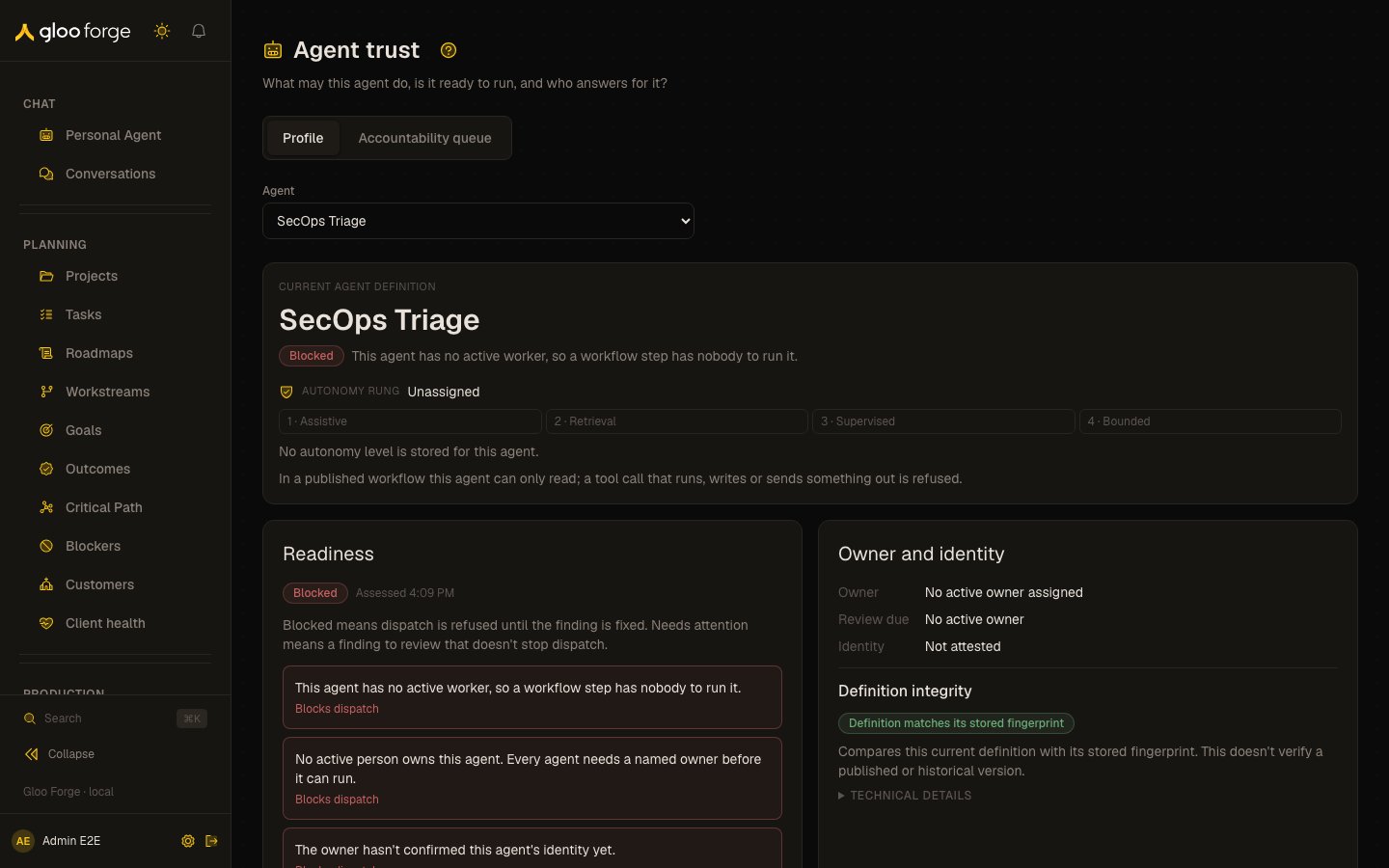
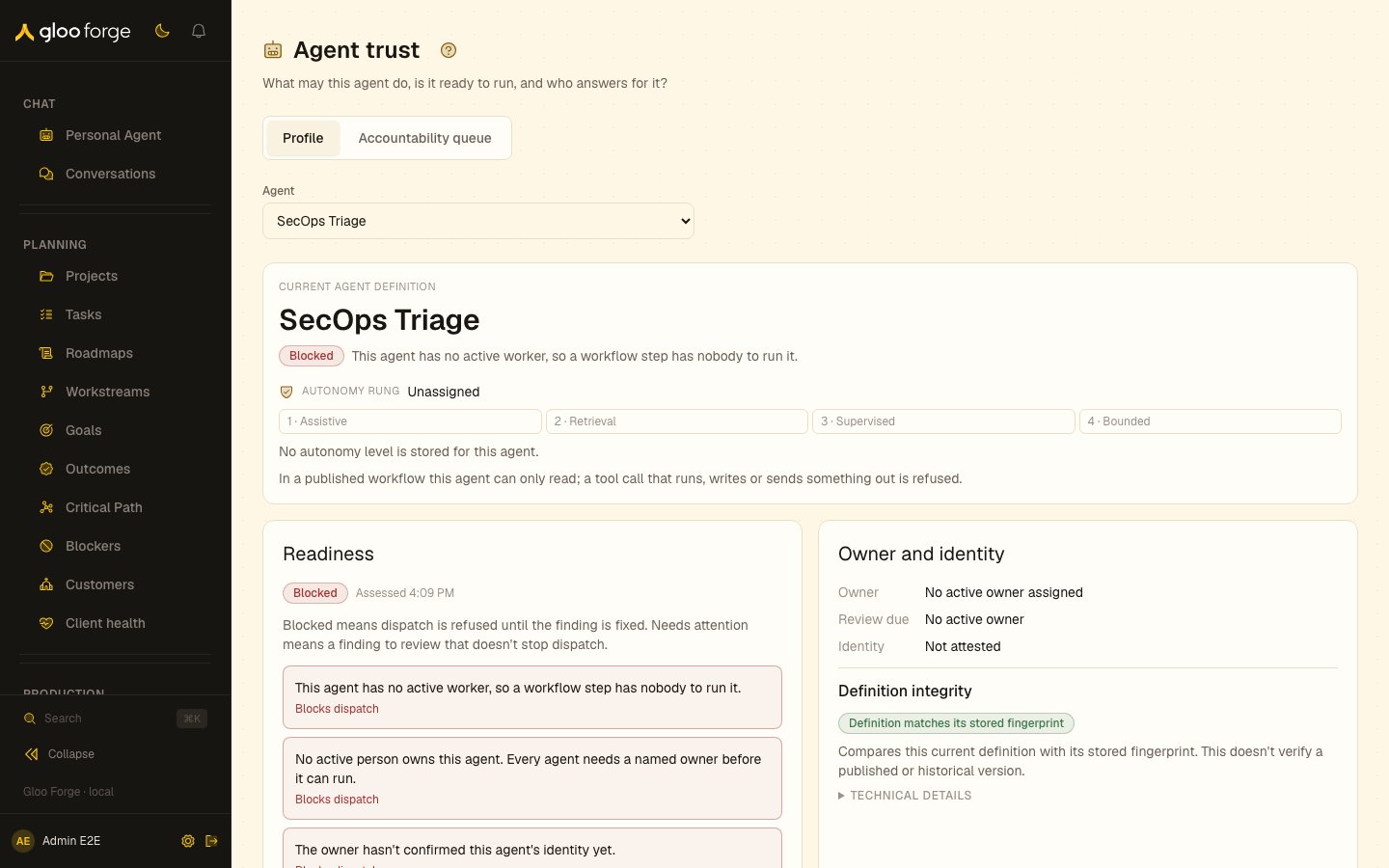
/trust-fabric/agent-trust) has two sections. Profile (?section=profile) shows one selected agent: what it may do, whether it is ready to run, and who answers for it, with the allow / block / hold decisions recorded for an exact identifier. Accountability queue (?section=accountability) lists every agent with an ownership, review or identity-attestation finding across everything you can read, and offers the repair for each. The two stay separate: the queue is never filtered to the selected agent.
Agent trust — Forge Console at /trust-fabric/agent-trust
grants:read at platform scope. Owner identity and definition hash are shown only to holders of platform agents:manage, which is also required for repairs.
What you can do
- Switch between Profile and Accountability queue. The address keeps
?agent=and any other parameter when you switch. - Select an agent. With nothing chosen, the profile opens on the first agent with accountability findings; if you can’t read the queue, or nothing has findings, it opens on the first agent in the list. Your own choice always wins.
- Read the profile’s hero: the agent’s name, its readiness badge and the assessment’s own sentence, and its autonomy rung as a four-step meter.
- Read Readiness: findings first, each with the repair the queue offers (Review ownership, Assign an owner or Attest identity); passed checks folded under a count; checks that do not apply listed as Not applicable.
- Read Owner and identity: the owner, the review date (Overdue in red when it has passed), the identity attestation, and definition integrity.
- Read when the readiness was assessed: the time only for today, the date and time otherwise. The autonomy sentence from that assessment sits under the rung.
- Choose Recorded for this definition to read decisions recorded with the stable definition ID, or Recorded with this name to read decisions recorded with its current name. These are separate histories; the page does not combine them.
- Page back through the agent’s recorded decisions. The page names the agent; the identifier the decisions were recorded with is under Technical details.
- Review the accountability queue, open a row’s Open profile, and repair each finding. The Console offers the repairs to holders of platform
agents:manage. The server decides each repair at the agent’s home org unit (at the platform for an agent with no home), and a PERSONAL agent has no unit home, so only a holder ofagents:manageat the platform can repair it:- Assign owner on an agent with no active owner. The person search needs
workforce:read, and the new owner must be able to see the agent. For a non-PERSONAL agent, this requires platformagents:read, matching the Console agent page; a unit-only grant does not qualify. A PERSONAL agent can be assigned only to the person it serves. - Acknowledge review on an owned agent whose review date is missing or overdue, stamping the next review date. An agent with no owner needs one assigned first.
- Attest identity on an agent whose attestation is missing, stale or expired. A confirm step shows the agent, its status, its owner and the first 12 characters of the definition hash before anything is written. The owner and review must be current first.
- Assign owner on an agent with no active owner. The person search needs
- Open
/trust-fabric/agent-trust?section=profile&agent=<recordedIdentifier>with a URL-encoded identifier. The page preserves that exact value, including a name or an unknown/deleted definition ID. - Open
/trust-fabric/agent-trust?agent=<agentId>with nosection: this is the accountability handoff’s published path, so it opens the queue focused on that agent’s row. Changing the picker does not change that focus.
agents:read. The decision timeline independently requires audit:read: a record reader without agent-list access can still open a direct identifier link. Edit links for a matched current definition open its current name under Workforce → Agents.
The rung is shown here but is not editable on this page. An agent’s rung is chosen at intake, on Workforce → Agents → Create, where it also drives the agent’s risk tier and therefore whether the deployment is auto-approved or sent for review.
Key state to watch
- Current autonomy rung — one of
assistive,retrieval,supervised, orbounded, the four steps of the autonomy ladder, shown as a meter. It is the agent’s stored autonomy level; whether a particular action waits for a person is set by the autonomy holds check, not by the level alone. Policy conditions can read it asagent.rung. An agent created before the rung was recorded reads Unassigned. - Readiness — Ready, Needs attention or Blocked, taken from the server assessment, not a trust score. An overdue or missing owner review is a blocking finding (the readiness check that predicts dispatch’s owner-review gate), so that agent shows Blocked and can’t run until the owner reviews it.
- Recorded decisions for this agent — the allow / block / hold record for the exact selected identifier, newest first. This is not a complete historical family or ownership record. The list loads one page at a time; “Load more” walks further back.
- Owner and review date — MSP guardrail D7 requires every agent to carry an active human owner and a review date. The queue labels each agent No active owner, Review date missing or Review overdue; “Assign owner” names the owner and “Acknowledge review” stamps a fresh 90-day review date.
- Identity attestation — an owner attests the agent’s current definition. The queue labels a gap such as Not attested, Definition changed since attestation, Owner changed since attestation or Attestation expired; “Attest identity” records a new attestation for the definition shown.
- Paging and partial results — the queue loads one page at a time; “Load more” continues even when a page comes back short or empty. Partial means some agents could not be checked, so the list may be missing findings.
- Changed since you looked — every repair sends the state the row showed. If the agent changed in the meantime, nothing is written and a message asks you to reload and review it again.