

/platform/capabilities) is the operator surface for the composable capability-provider registry. Every platform-level external dependency — LLM inference, secrets, project management, org structure, embeddings, notifications, sandbox, file hosting — is served through a pluggable provider pattern. The page exposes the active chain per capability domain and lets operators reorder or disable individual providers.
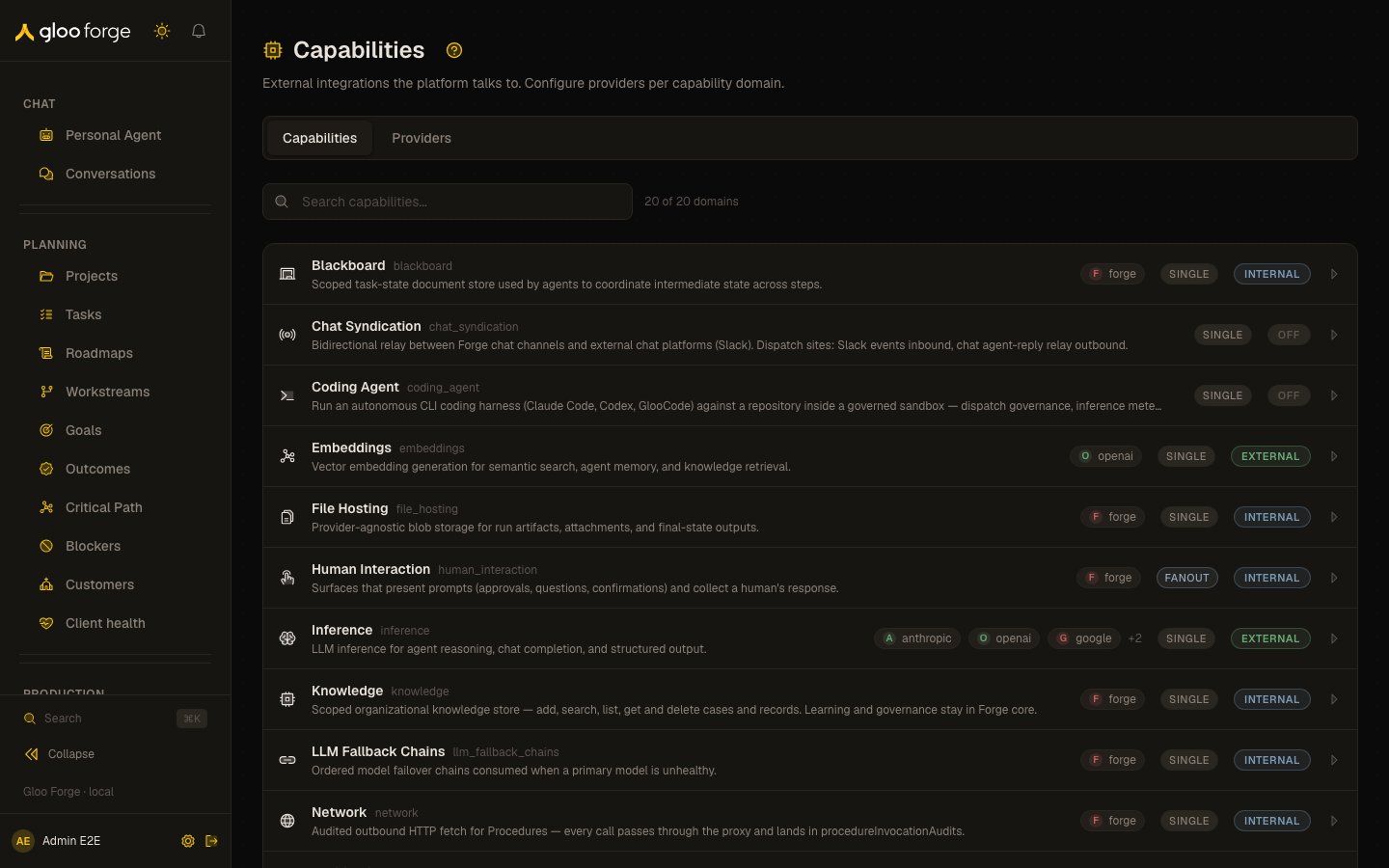
Capabilities — Forge Console at /platform/capabilities
What you can do
- Browse every capability domain and its current provider chain.
- Inspect a chain — the operator-selectable providers and the foundation provider (pinned by platform code, cannot be removed).
- Add an external provider to a chain when its credentials are configured; the page surfaces what env vars the provider expects.
- Reorder providers within a chain. In a Single domain the enabled provider at the head of the chain is the default: it serves every call that a more specific route does not send elsewhere. Those routes are an organization binding (File hosting, Source control and Typed Judgements), a model’s route (Inference), and the provider an existing item was stored with. Forge does not fail over to the next entry when the provider errors. In a Fanout domain every enabled provider whose credential resolves receives the call; one that fails to resolve is left out and logged.
- Disable an external provider without removing it; disabled providers stay in the chain for audit but receive no traffic.
- Inspect Slack workspace installations by connection and workspace ID, including provider health and the credential binding used at runtime. Slack appears within each capability it provides rather than as a vendor-owned parallel subsystem.
- Inspect GitHub’s distinct
rest,graphql, andmcpconnection surfaces. A provider that needs REST and GraphQL resolves both credentials independently; Forge does not copy a token from one connection into another. The retiredapiconnection is not a compatibility fallback. - Provider credential rows appear only when you hold
credentials:readat that Credential’s scope. Provider resolution remains visible without those rows. Provider options reject secret-shaped keys and values; store secrets as Credentials on the vendor Connection.
In a Single domain the chain editor’s mode line reads “remaining entries are fallback on error”, the
chain list labels every entry after the first “Fallback”, and the foundation’s lock icon reads
“Always at head of chain”. At runtime none of these holds: no entry takes over when the head
provider errors, and the foundation sorts after the other enabled providers.
Key state to watch
- Foundation provider — usually
forge(Convex-native). Forsandboxit’svercelsince there is no Convex-native VM. - Which provider serves. Enabled providers are ordered by priority, and the pinned foundation sorts after them, so it is a Single domain’s default only when no other provider is enabled. A failing head provider is not skipped: fix or disable it.
- Slack installation health — a usable installation has one active connection, one Slack team
identity, and one exact
slack/botForge Credential with matching org-unit scope. That single connection-linked credential serves notifications, human interaction, chat syndication, publish, and org structure; capabilities do not create or select their own Slack credentials. Missing, ambiguous, revoked, expired, unhealthy, or cross-scope bindings fail closed. - Slack live verification — Verify workspace calls Slack
auth.testthrough the exact connection-linked credential and validates both workspace and bot identity. The Vendor detail shows the same credential as Slack OAuth managed; token lifecycle is managed from this workspace surface rather than edited on the Vendor page. - SendGrid credential health — one system-scope
sendgrid/apiForge Credential serves the three SendGrid providers: notifications (emailchannel), human interaction (email replies), and publish (theemaildestination). Each provider record ships disabled. The healthcheck reads SendGrid/v3/scopeswith that Credential’s key: healthy whenmail.sendis granted, down when no Credential resolves ormail.sendis missing, and degradedcredential_presentwhen SendGrid refuses the scopes read. - GitHub credential health — provision and verify token-backed credentials separately for
github/rest,github/graphql, andgithub/mcp. The source-control and project-management providers require both REST and GraphQL to resolve; a missing surface fails closed and remains visible as not provisioned.
Typed Judgements organization readiness
Fortyped_judgments, select the organization on the capability detail page and inspect
Organization readiness. You need credentials:read at that organization to read this scoped
projection. It checks the organization’s provider binding, the enabled TypeSafe provider, and the
approved production Credential elected for typesafe/typed-judgments at that exact organization.
The Credential must have its API key provisioned. A system Credential or another organization’s
Credential does not satisfy this check.
Ready means those dependency records are configured. It does not probe the TypeSafe API key
or grant a workflow permission. A Not ready explanation identifies the missing binding,
disabled or mismatched provider, or missing production Credential. Fix the corresponding record
on the existing capability or Vendor connection surface. Secrets
and credential identifiers are not included in this readiness response.
Capability enablement and deployment-level provider health remain separate. An organization can
have the correct Credential while a system connection is unconfigured; that is not a reason to
copy its key into a system Credential. The organization’s readiness also requires its selected
provider to be enabled.
Before publishing, Forge checks the pinned typed procedure’s declared capability, connection,
procedures:use, and external-delivery declaration, its bounded organization bindings and planned
workflow-version acting-for authority. Publication refuses missing dependencies rather than
publishing a version that cannot use them. Procedure metadata reads select and cache exact pinned
versions, including the legacy lookup path; unavailable metadata blocks publication.
At execution, the governed procedure proxy rechecks current persisted identity and authority before
credential resolution or TypeSafe delivery. Revoking a published version’s grant prevents a
retained signed invocation from using it. Published version authority remains distinct from the
person authority used for attributable draft or debug execution.